

Skip to Content
Columns

The Alternative Number Ones: Nirvana’s “About A Girl”

In The Alternative Number Ones, I'm reviewing every #1 single in the history of the Billboard Modern Rock Tracks/Alternative Songs, starting with the moment that the chart launched in 1988. This column is a companion piece to The Number Ones, and it's for members only. Thank you to everyone who's helping to keep Stereogum afloat.

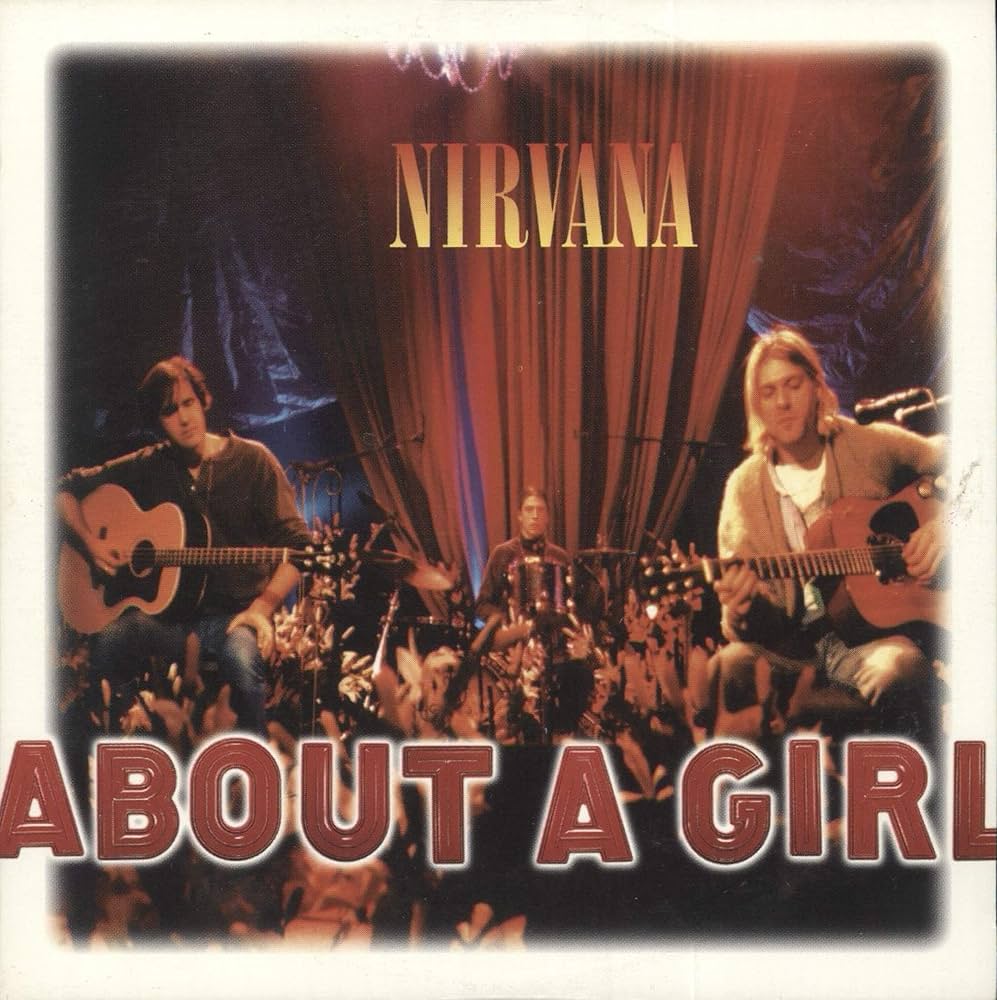
"This is off our first record. Most people don't own it." Kurt Cobain doesn't say too much to the crowd during Nirvana's MTV Unplugged In New York, but the show, TV special, and live album all open with that perfunctory bit of stage patter. What Cobain says is technically true. The population of the United States was about 260 million in 1993, and Bleach didn't go platinum until 1995. Even if you factor in bootlegs, home tapings, and passed around copies, most Americans, most people, did not own Bleach. But that's still a million fucking people buying a sludgy, unforgiving rock record that was released independently and recorded for $600. People own Bleach because they're caught up in the whole Nirvana mystique or because they've already run Nevermind and In Utero into the ground or because they would feel like posers if they did not own Bleach. But plenty of people also own Bleach because "About A Girl" is a great fucking song. Presumably, some people own MTV Unplugged In New York for the same reason.

I'm probably reading too much into a stray bit of stage patter -- something the often camera-shy Kurt Cobain said because he didn't know what else to say -- but he sounds a little proud of the idea that most people don't own Bleach. Reportedly, Cobain spent a long time negotiating with MTV over taping an Unplugged episode, and when he finally agreed to do it, the network wanted him to play the hits. He refused. So maybe there's a trace of defiance in the way that he introduces "About A Girl." Maybe he thinks he's throwing it in MTV's face: Guess what, bitches? I'm opening with a song that most people don't know. But that's the problem with being Nirvana. Cobain was evidently much more charismatic than he wanted to be. His relatively old and obscure song still sounded like a hit. After his passing, a hit is what it became.

When people talk about Nirvana's pre-major label days, "About A Girl" always comes up. In the context of Bleach, "About A Girl" is the standout, the sign that this band was about something more than skree-thud. They were also exceptional at skree-thud, and that was no small thing on the late-'80s underground. Just based on the freaked-out roar of tracks like "Floyd The Barber" and "Negative Creep," Nirvana were among the most powerful acts from their neck of the woods. But "About A Girl" was something else -- a tense, confused, catchy guitar-pop jam that hinted at melodic gifts far beyond anything that anyone might've expected of Kurt Cobain.

The title is good, too. Former Nirvana drummer Chad Channing took credit for that one. Cobain wrote a song, but he didn't have a name. He told Channing that it was about a girl, so Channing told him it should just be called "About A Girl." Simple. Clean. Efficient. The words "about a girl" never appear in the lyrics, but they stick in your head anyway. The title gives you a frame of reference, a way of approaching the track. Nick Hornby liked that title enough to flip it for the name of his novel About A Boy, and then that book became a Hugh Grant movie, and now we get to see what happens when Nicholas Hoult, the titular child-actor boy, gets obsessed with killing Superman.

The titular girl is Tracy Marander, Kurt Cobain's girlfriend at the time. She's the one who took the photo on the Bleach cover. Marander was one of the 15 people at the first Nirvana show. Later, Cobain and Marander lived together in a studio apartment in Olympia, Washington, and they had a whole army of pets -- five cats, along with rabbits, turtles, a bird, and rats. (The rats were pets, too. They didn't just have rats.) Imagine how that fucking place smelled. During that time in Olympia, Marander worked at the Boeing cafeteria, and she paid the rent. Cobain was usually unemployed. He didn't clean the apartment much, either. He sounds like a true scumbag boyfriend, a fucking embarrassment. Imagine if more scumbag boyfriends turned out to have actual greatness in them.

The legend is that Marander would sometimes ask why Cobain never wrote a song about her, and then he never told her that "About A Girl" was what she requested. She later said that she learned it was about her when she read Michael Azerrad's Nirvana book Come As You Are. Supposedly, Cobain wrote the song after a day of listening to the first Beatles album on repeat. You can tell. Cobain recorded a solo home demo of "About A Girl" sometime around 1988, and it eventually came out on a Nirvana box set. Even in that first lo-fi version, presumably recorded in that apartment with all those animals, the melody really hits. The full-band Bleach version immediately jumps out from the rest of the album. It sounds rich and bittersweet and completely self-assured. Jack Endino, the Skin Yard member who recorded Bleach, was not used to producing songs like that, but that version adds more sharp, immediate details, like the revved-up guitar solo and the tambourine that accompanies it.

According to the journals that were published after his death, Cobain was in the proverbial doghouse when he wrote "About A Girl." Tracy Marander was pissed at him, and he strikes me as the kind of guy who would not be able to stand his girlfriend being pissed at him. But "About A Girl" isn't a complaint, exactly. It's a little less opaque than most Nirvana songs, but that doesn't mean it's lyrically straightforward, either. At least from what I can tell, Cobain does not go out of his way to make himself sympathetic on "About A Girl."

Once you know the circumstances of Cobain's life, the lyrics make a little more sense. "I'll take advantage while you hang me out to dry" -- he's still eating her food and sleeping in her bed, even when she's not happy with him. "I can't see you every night for free" -- he's a little uncomfortable with the fact that he's living off of her while contributing nothing. When he says that he needs an easy friend, he's talking about hating the complications that necessarily come along with building a life with another human being. He repeats the phrase "I do" over and over -- maybe mocking the idea of marriage, maybe wistfully envisioning a time when he'll be able to be someone's husband, maybe both. That's my read, anyway.

"About A Girl" pulls off a neat trick, working as the underground rock version of a pop song without compromising either its rawness or its popness. On "About A Girl," Cobain sounds ragged and wrecked, and there's just a hint of high-lonesome country singer in his scraggly yowl. The ascending notes of the chorus -- "I can see you every night" -- are just killer. There's no bridge, but the guitar solo has enough melodic richness to qualify as one. It's the type of guitar solo you can sing along with. The track is bottom-heavy and grimy and cheap, and it's still immediately likable. Dinosaur Jr. were Nirvana's elders at the time, but they had to cover the Cure to pull off anything like that.

Bleach came out in 1989 and slowly turned into an underground sensation. Kurt Cobain and Tracy Marander didn't last long. He might've been seeing his next girlfriend, Bikini Kill's Tobi Vail, before he and Marander definitively split. Cobain and Marander broke up around the same time that he fired Chad Channing from Nirvana. As Nirvana toured the world, playing to increasingly bigger crowds, "About A Girl" remained a setlist staple. Plenty of people have talked about being struck by that song, about how it suggested that Nirvana were more sophisticated and ambitious than they might've initially seemed. Cobain later said that it was "risky," at least in his social circles, to put a song as pop-friendly as "About A Girl" on Bleach, and I'm sure it was on some level. But "About A Girl" is probably also the primary reason that Nirvana got the major label look in the first place. It's the greatest early sign that the band had something bigger in them.

Fast-forward four years, and it turns out Nirvana had something much bigger in them -- bigger than the band or their new label bosses had any reason to hope. That bigness didn't make sense to Cobain, and he pushed hard against it. In some ways, Nirvana's third album In Utero is a reaction against the success of Nevermind, but it's too strong of a rock record to be heard as a pure tantrum. In Utero still sold a ton of copies and sent two singles to #1 on the Modern Rock chart, but it didn't do anywhere near as well as Nevermind. Nobody was surprised. In Utero was intentionally designed to be relatively difficult.Nirvana were in uncharted territory, trying to figure out how to approach success on their own terms. That's where MTV Unplugged comes in.

By 1993, MTV Unplugged was an institution and a serious commercial force. The show launched in 1989 as a passion project for a couple of MTV producers, and it took a little while to find its feet. Within a few years, however, the acoustic-performance showcase became a hugely important part of the music business. Eric Clapton's 1992 Unplugged album sold a bajillion copies, and it seemed like all my friends' houses had that CD. Mariah Carey's Unplugged album was another blockbuster, and her cover of "I'll Be There" was in the other Number Ones column. You could argue that Unplugged reached its true peak in 1995, when Tony Bennett won the damn Album Of The Year Grammy for his entry in the series. I still can't believe that happened. Not everyone who went on Unplugged turned their episodes into mega-selling albums, but the show was a way for aging rockers to get MTV rotation and for fluffy pop acts to prove their chops. For example: The two acts who taped Unplugged episodes just before Nirvana were Duran Duran and Roxette.

Nirvana were not a natural choice for MTV Unplugged. They were a plugged band. They were loud and intense and primal. They had a few quieter songs, but the quieter songs were not their calling cards. Still, the band considered how their version of the show could work if they did it their way -- staying away from the big hits, covering some of the songs that they loved, designing the stage the way they wanted. Kurt Cobain was an R.E.M. devotee, and he was talking to Michael Stipe about maybe making music together, so there's some chance that future Nirvana records would've gone in an Unplugged-style direction if he hadn't taken his own life. Cobain had already played around with music that nodded in more traditional directions. In 1990, for instance, Cobain and Krist Novoselic played noisily but prettily on Screaming Trees leader Mark Lanegan's "Where Did You Sleep Last Night," a version of "In The Pines," a folk traditional that Leadbelly recorded sometime in the '40s. Maybe something like that would work. I would guess that Nirvana were under some label pressure to accept the Unplugged invitation, too. Eventually, they said OK.

Nirvana recorded their Unplugged episode in November 1993, a couple of months after they released In Utero. They presented their setlist to unthrilled MTV executives before the taping, and they refused to accept the network's suggestions. Alex Coletti, the MTV exec who's credited with producing Nirvana's Unplugged album alongside R.E.M. collaborator Scott Litt, says that the network was hoping that Nirvana would bring in big-name guests like Eddie Vedder. Instead, the only guests that night were the Kirkwood brothers from the Meat Puppets, the Arizona cosmic punk legends who were on tour as Nirvana's opening act when they accepted the Unplugged gig. Nirvana devoted the middle of their set to covering three songs from the Meat Puppets' 1984 album II, an underground classic but not exactly prime MTV fare. (The Meat Puppets' highest-charting Modern Rock hit, 1994's "Backwater," peaked at #11.)

One of the most famous anecdotes about Nirvana's Unplugged is that Kurt Cobain told Alex Coletti he wanted stargazer lilies and black candles onstage with the band. Coletti asked, "Like a funeral?" Cobain answered, "Exactly, like a funeral." When you hear that story about someone who would be dead by his own hand six months later, it's tempting to read into it. I try to resist that urge. If you're planning your own death and curating your legacy, you probably don't take the MTV invitation. Nirvana understood their own presentation, and the stage looked cooler than it would've looked if they'd left it up to MTV. And honestly, I don't remember being the least bit surprised about how Nirvana structured their setlist. Their Unplugged episode has the kinds of covers that you would expect them to play, and it's also got every halfway quiet and pretty song in the band's entire discography, "About A Girl" included. They did what made sense.

Kurt Cobain was still ambivalent about the Unplugged thing before he played the show. He was going through heroin withdrawl when he did the taping, and he threatened to cancel on the night before the show. He also thought about telling Dave Grohl not to take part, since he thought Grohl would play his drums too loud and overwhelm everything else. That's probably why Grohl goes with the brushes all through the performance. Grohl is even styled like he's attempting to civilize himself -- turtleneck, slacks, hair pulled back in a ponytail, looking like the school burnout who's trying to make himself presentable for a court date. (He does quietly bash out the "Scentless Apprentice" intro at one point between songs, though. Grohl's always gotta be Grohl.) Cobain was still ambivalent after the show. Amy Finnerty, Cobain's friend who worked at MTV, later claimed that Cobain thought the audience wasn't into the set because they were so quiet. He couldn't understand the idea that everyone in that room was watching with hushed awe. It wasn't part of his vocabulary.

Here's something fucked up: Most days, I think MTV Unplugged In New York is the best Nirvana album. I don't feel confident about this opinion. It feels contrarian and basic at the same time, which is impressively wack even for me. Cobain might've seen Unplugged as a concession, an obligation. I don't love the idea that MTV's logo is on the cover of the best Nirvana album. But the results speak for themselves. Cobain's voice is at its most tender, vulnerable, and pained. The space in the arrangements, with touring guitarist and former Germ Pat Smear and cellist Lori Goldston in there to thicken things up, gives the melodies a lot more room to breathe. You can get lost in tragedy when you listen to Unplugged, or it can just work as pretty music to have on in the background when you're making dinner. It's a fucking incredible rock record, and it opens with "About A Girl."

Now that every moment of Nirvana's existence as a band has been monetized to death, we can hear tons of different live versions of "About A Girl," as well as the solo demo and the Bleach original. I still think the Unplugged version is the definitive one. Even in acoustic form, the riff still hits. If anything, the Unplugged arrangement brings out its power-pop side. Lori Goldston doesn't play on "About A Girl," but I sometimes hallucinate her cello in there, anyway; there's a low-end resonance that works almost as a ghost melody. Cobain's guitar solo still sounds fiery and dangerous when played acoustically. In this form, the song has a strange balance of lightness and heaviness. Cobain was years removed from Tracy Marander when he did that taping, but his voice still conveys plenty of confusion and attraction longing and shame. Lord knows he would've had plenty of opportunity to feel all those things in the last days of his life.

MTV Unplugged In New York was not the end for Nirvana. A week after the taping, Nirvana were back out on the road, playing Morocco Shrine Auditorium in Jacksonville, with the Breeders and Come as their openers. A month later, they taped another set for MTV, the one that came out as the Live And Loud album and video. (Cypress Hill opened for them at that show, which is fun to think about.) Nirvana kept touring until just before Kurt Cobain first attempted suicide. The Unplugged special was not a goodbye. It just felt like one. Cobain died in April 1994. In August, DGC announced plans for a double live album called Verse Chorus Verse; the Unplugged special was going to be the second disc. But Krist Novoselic and Dave Grohl couldn't handle going through the live tapes and putting together the rest of the compilation, so DGC changed plans and released MTV Unplugged In New York on its own in November 1994, just under a year after Nirvana taped the episode. People were already bootlegging the episode, so DGC didn't think it could wait much longer.

MTV Unplugged In New York got rapturous reviews and debuted at #1, selling more than 300,000 copies in its first week. It ultimately sold eight million copies in the US alone -- less than Nevermind but more than In Utero or Bleach. On the 1994 Pazz & Jop poll, the Unplugged album came in at #4, between two LPs from artists that Kurt Cobain admired, R.E.M.'s Monster and Neil Young's Sleeps With Angels. That year, Hole's Live Through This came in at #1, deservedly. Live Through This would still be a colossal record in any circumstance, but that list really illustrates how the rest of the year existed in the shadow of Cobain's absence. DGC pushed "About A Girl" to radio, and the song got airplay on mainstream rock and pop stations, as well as alternative ones. I think I remember hearing the original Bleach version of "About A Girl" once or twice on alt-rock radio when Cobain was alive, but I can't swear to it. In any case, Unplugged turned "About A Girl" into an actual hit.

Another MTV Unplugged In New York song became an actual hit, too. After "About A Girl," DGC pushed Nirvana's haunted cover of "The Man Who Sold The World," a song that David Bowie released in 1971, and it reached #6. (It's an 8. David Bowie's highest-charting Modern Rock single, 1993's "Jump They Say," peaked at #4. It's a 6.) A much louder Nirvana live album, From The Muddy Banks Of The Wishkah, came out in 1996 and went platinum. On the Modern Rock chart, that record's live version of the "Smells Like Teen Spirit" B-side "Aneurysm" reached #13.

By the time MTV Unplugged In New York came out, Dave Grohl was already figuring out his next chapter. In November 1994, Grohl played drums for Tom Petty's Heartbreakers on Saturday Night Live. (That episode's host: John Turturro, who must've been promoting Quiz Show.) Petty's drummer Stan Lynch had just quit the band, and Grohl was honored to be asked. But when Petty offered Grohl a permanent spot in the Heartbreakers, Grohl said no. He already had something else in the works.

In October 1994, before that SNL performance, Grohl secretly went into a Seattle studio and recorded a bunch of songs he'd written, playing every instrument himself. He thought about putting that music out anonymously. Instead, he assembled a band, and he called it Foo Fighters. Krist Novoselic declined an invitation to rejoin Grohl in the new group, so Grohl recruited the former rhythm section from Sunny Day Real Estate, who'd just broken up, as well as Pat Smear, who'd been Nirvana's touring guitarist at the very end. The Foo Fighters' self-titled debut came out in summer 1995, and their debut single "This Is A Call" reached #2 on the Modern Rock chart. (It's an 8.) The Foo Fighters will appear in this column a bunch of times. Nirvana will be back in here, too.

GRADE: 10/10

BONUS BEATS: In 1999, Cibo Matto released an "About A Girl" cover that really went crazy with the song's pop qualities, turning it into a go-go '60s lounge pastiche. It's pretty great. Here it is:

BONUS BONUS BEATS: Here's the grimy, revved-up version of "About A Girl" that Bully released in 2020 -- on Sub Pop, no less:

BONUS BONUS BONUS BEATS: In 2020, Puddle Of Mudd went viral for playing an acoustic cover of "About A Girl" in a radio-station session. It's not easy to recreate Kurt Cobain's throat-scraping howl, and Wes Scantlin should not have tried. I don't generally like to indulge in point-and-laugh internet theatrics, but this column will eventually have to contend with Puddle Of Mudd, so we might as well prepare ourselves:

THE 10S: Well, shit. This is sad. As with the 1994 Pazz & Jop poll, Kurt Cobain and his widow Courtney Love were on the Modern Rock chart at the same time. Hole's guttural insecurity anthem "Doll Parts," which started out as a love poem that Love wrote for Cobain, peaked at #4 behind "About A Girl." I love it so much, it just turns to -- well, no, it doesn't turn to hate. It's a 10.

(Hole will eventually appear in this column.)

GET THE STEREOGUM DIGEST

The week's most important music stories and least important music memes.