Skip to Content
Columns

The Alternative Number Ones: Better Than Ezra’s “Good”

April 29, 1995

  • STAYED AT #1:5 Weeks

In The Alternative Number Ones, I’m reviewing every #1 single in the history of the Billboard Modern Rock Tracks/Alternative Songs, starting with the moment that the chart launched in 1988. This column is a companion piece to The Number Ones, and it’s for members only. Thank you to everyone who’s helping to keep Stereogum afloat.

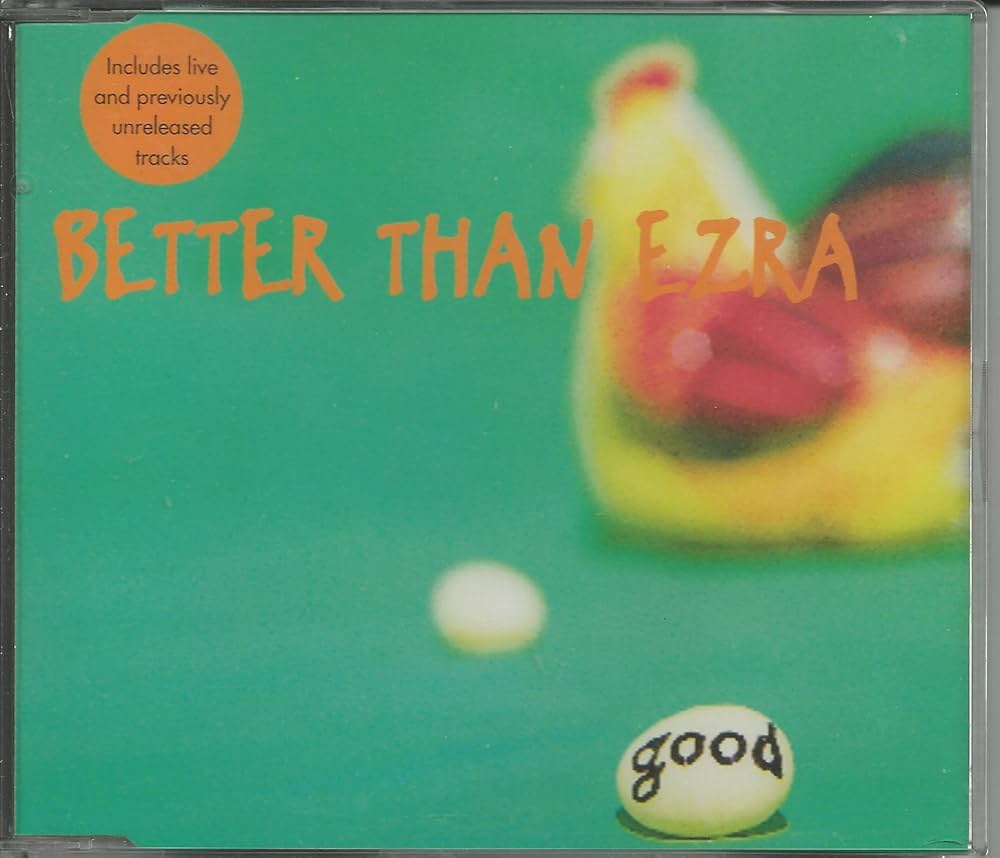
"Ah-haw!" "Wah-hawww!" "Ahhh-hawooowoahh, ah-haw!" "Ahhh-hoo-good!" There's a grand total of one actual word in those lyrics, and it's the title of the song. That's too bad. It feels like a missed opportunity. The English language is a miraculous human invention, a system capable of transmitting all kinds of thoughts and feelings and images and bits of information. But sometimes, the English language isn't enough. Better Than Ezra's "Good" is a good song in search of a good song title. "Good" is not a good song title, and that word is not the part of the song that everyone remembers. But thanks to the vagaries of music marketing, you can't really have a song called "Wah-hawww!" So "Good" just became the Better Than Ezra song. There are lots of Better Than Ezra songs, but "Good" is the Better Than Ezra song.

This column will get into the Better Than Ezra story, which is both mundane and miraculous in the same ways that so many '90s alt-rock stories are. In the realm of '90s alt-rock, you've got your legendary, canonized figures, and then you've got your "remember some guys" guys. Better Than Ezra fit firmly into the second category. "Good" was the first Better Than Ezra song that the world heard. They went on to make a lot of other songs, some of which were actual no-joke hits, none of which were hits on the level of "Good." They're still a band today, and frontman Kevin Griffin, like Geggy Tah's Greg Kurstin and 4 Non Blondes' Linda Perry and Semisonic's Dan Wilson, is one of those figures who became successful for-hire songwriters after their bands' brief hitmaking runs ended. But for so many of us, Better Than Ezra will always be the "wah-hawww!" band -- the group with the weird name who made a great, evanescent summer singalong and who will always exist in that one moment, like a faded Polaroid that we sometimes re-discover buried in a junk drawer. There are worse legacies than that.

This is going to be a nostalgia column. Sorry. Can't help it. I'm sure there's someone somewhere who can attempt an objective analysis of the merits of Better Than Ezra's "Good." It won't be me. I reject the notion that something like that should even be attempted. Music criticism is an entirely subjective medium. We are not scientists here. We are dredging through our own memories, inclinations, preferences, and moments of personal activation, and we're trying to figure out how and why that stuff worked. For me, Better Than Ezra's "Good" comes down to one moment, one morning, in a car.

Here's my "Good" moment: It's June 1995, and I'm on my way to the HFStival, the annual all-day live-music marathon that my local alt-rock radio station throws at RFK Stadium in Washington, DC. It's my first HFStival. I'm 15. My friend Nat's mom is taking us. Nat's mom works for UPI, and she usually writes about real estate, but she's somehow successfully pitched a story about taking a bunch of kids to their first music festival. It's my second music festival, but whatever. She has somehow cadged press passes for us, and this will lead us to a somewhat awkward backstage sit-down with Mike Watt later in the afternoon. (Watt, the Minutemen legend and underground-rock lifer, is enjoying a brief moment of mainstream visibility. His only Modern Rock hit, the Eddie Vedder/Dave Grohl collab "Against The 70s," peaked at #21 a few months ago. I do not really understand this man's importance at this point in my life. I want to talk to him about punk rock, and he's trying to tell me about Superchunk, which doesn't sound like punk to me.) When we get to the stadium, I will be bummed to learn that we have seats up in the bowl of the stadium, not floor tickets. Then I will get a rush of euphoria to learn that all the kids in the bowl just rush the barricade and jump onto the floor en masse and security never bothers to stop them. It's ours! It's all our turf!

None of this has happened yet. It's still glimmering in the immediate future. I'm in Nat's mom's car with Nat and his mom and two other kids, a girl Nat has known for a long time and her boyfriend. I don't know these other kids, but they're really nice. They're not punks in training like me and Nat. They just like the songs on the radio. When the Friends theme comes on, they get excited, and that makes me like the Friends theme more. When the radio plays "Good," these kids positively levitate. They sing along at top volume: "Lookin' around the howwwwse! Haiy-din' behin' the waaayn-down an' the doo-uh!" Their joy is infectious.

I'd heard "Good" on the radio a bunch of times already before that moment -- it had just finished a five-week run at #1 -- but I hadn't paid it much mind. In that moment, though, I could suddenly hear this song as the bouncy guitar-pop banger, the vector for teenage enthusiasm, that it really is. I couldn't have put it into words at the time, but that was a weirdly formative moment for me, a step along the way to hopefully not being such a damn snob about music all the time. I wouldn't fully internalize its lesson until years later, but that moment stuck. So did the song attached. That doesn't make "Good" a masterpiece or anything, but it does turn the song into a time machine, a core memory. It's a huge part of the reason that I think "Good" is a good song.

We saw Better Than Ezra later that day. Or I think we did, anyway. They definitely played the show. They were on the main stage right between Juliana Hatfield and Mike Watt. 120 Minutes interviewed them backstage, and they said it was the biggest show they'd ever played. Maybe we didn't watch them, though? Maybe that was when we went out to the second stage in the parking lot to see Tripping Daisy and Candy Machine. Or maybe we were in the rave tent or something. I remember some of that day's performances with bracing clarity, and others are like "oh yeah, I guess I saw some of that." If I did see Better Than Ezra play "Good" in that stadium, I don't really remember it. It's not a core memory like the car singalong. The enthusiasm of an entire stadium did not sweep me up the way these two kids in the car did. Better Than Ezra themselves are pretty incidental to my memories of that day, but "Good" is not.

Anyway, this isn't a column about what I remember from the 1995 HFStival, about feeling like I was about to get crushed to death during surprise guest Courtney Love's mini-set or about getting high and crowd-surfing during surprise guest Tony Bennett's mini-set. It's about Better Than Ezra and "Good," so let's talk about Better Than Ezra. Kevin Griffin and some friends started Better Than Ezra when they were students at Louisiana State University in the late '80s. They have always refused to discuss why they picked that random-ass band name, but Griffin was an English major, and the first song on their first album was called "Ezra Pound," so that's a clue. At any rate, random-ass band names were the coin of the realm in the '90s. It's the most mysterious thing about a band that doesn't have a whole lot of mystery otherwise. Nobody was upset about the name. The phrase stuck in your head.

Early on, Better Than Ezra played parties and small shows. I can't find too much information about their early days, but they used to close their shows by covering Echo And The Bunnymen's "Do It Clean," which gives me the sense that they probably covered a lot of the alt-rock songs of that particular moment. They toured around a little, too. When they all got out of college, they moved from Baton Rouge to New Orleans. In 1990, they made an album called Surprise and released it on their own, pressing up a few thousand cassette copies, and then reissued it 25 years later. I'm listening for the first time now, and it's a pretty good example of that era's college-rock splinter-churn. It will not surprise you to learn that Better Than Ezra were into R.E.M.

Around the same time that Surprise came out, Better Than Ezra guitarist Joel Rundell, Kevin Griffin's friend from high school, died by suicide. That must've been a hell of a blow. The band broke up for a little while. I think that's when Griffin temporarily moved to Los Angeles and got a job with CAA. Eventually, though, they decided to keep the band going as a trio. In 1993, they self-relased another album, and this one was called Deluxe. (Back then, you could use Deluxe as an album title without making people think it was some other album's deluxe edition.) They recorded Deluxe with producer Dan Rothchild. Dan's father Paul was a legendary producer who'd worked with the Doors and Janis Joplin, but Dan was a session bassist who had never produced much of anything before that. Deluxe was the album with "Good" on it.

Kevin Griffin has said that he first wrote "Good" way back in 1990. At the time, it was an experiment. He wanted to see if he could write a song using the same four chords. Griffin's lyrics told a story about a situation he'd never personally experienced -- arriving at home and finding a letter from a partner telling him that things were over. Years later, Griffin told Songfacts, "I wanted to talk about the positive things that come from the end of a relationship. There's always the hurt feelings and everyone's guarded and it can be traumatic, but when the dust settles, it was about looking at the good things, no pun intended, that you got from that relationship." And that's how he landed on "it was good living with you." Ah-hawwwoah-wah.

Griffin says that the catchiest parts of "Good," the "wah-hawww!" bits, were originally placeholders. He thought he'd come back and think of some actual words for those parts. But when Better Than Ezra first played "Good" in Oklahoma City, people came up to him to ask about the wah-hawww song, so he knew he had something. Apparently, Griffin actually offered "Good" to another artist, who didn't think that the song had enough of a hook. Later on, when "Good" blew up, that artist's A&R guy played him "Good," telling him that he should be trying to write songs like that.

"Good" is a good song, but I'm not sure it's the kind of good song that you can just offer to someone else. The song's strengths are pretty unique to the recording. A lot of it is Kevin Griffin's delivery. He's got a bit of a Louisiana accent, but it's not too thick; he's not Lil Boosie. His voice comes off as a half-ironic college-kid drawl -- not enough to sound like he's just making inside jokes with his bandmates, but enough that he doesn't seem to take things too seriously. He's sings about the sudden onset of loneliness, but he brings a charged-up energy to it. As the song ends, someone -- maybe Griffin, maybe someone else -- lets out a screech: "Yeah, that's right!" It's crazy distorted, like it's coming from a speakerphone, and the comic timing is immaculate. When "Good" played on the radio, DJs loved to riff on the "yeah, that's right!" bit. It's a perfectly unserious touch, something Beck or the Beastie Boys might've done.

"Good" doesn't sound like Beck or the Beastie Boys, though. It sounds like spiky power-pop. In this column's comments section two weeks ago, people pointed out that "Good" has the same chord structure as Green Day's "When I Come Around." I don't know jack shit about chords, though the two songs do have a similar fizzy bounce. But nobody ever accused Better Than Ezra of being a punk band. Instead, "Good" sounded like someone applying serrated grunge sonics to a catchy garage-pop song. The songs on Surprise, Better Than Ezra's first album, lean toward catchy garage-pop, too, but the sound itself is more of an R.E.M.-style swirl-jangle. With "Good," you can hear them moving toward the raw immediacy of the Pixies. It makes a difference.

Man, "Good" is fun. It's simple and direct, and it's got this happy-seething thing going on. The bassline is about as simple as a bassline can be. The guitar is just erratic stabs on the verses and then pedal-mash catharsis on the chorus. It builds and builds. I never really understood the song's storyline when I was a kid, and it never really makes itself too clear. But when the song really gets going, there's a combination of affection and regret in Kevin Griffin's delivery. His narrator might see his ex again. Maybe he'll get a letter on the Fourth of July. Things are over, but that doesn't mean they ended with acrimony. It's just: "It was good living with you." Ah-hawwwoah-wah.

Someone at Elektra heard Deluxe, and they signed Better Than Ezra and re-released the album in 1995. Better Than Ezra shot a low-budget video for "Good," and the song took off much quicker than anyone expected. Later on, Kevin Griffin told CNN, "It took us seven years to get signed, and then seven weeks to get to #1." The song landed in that moment's alt-rock sweet spot. It was rough but catchy, sweet but weird, grunge-adjacent but not grunge. It didn't strive for significance. It sounded a bit like Green Day, to the point where I wonder whether that's why Elektra picked the band up, but it didn't sound like a band trying to sound like Green Day. (We would get plenty of those.) This was the beginning of a very good time for radio-friendly alternative rock one-hit wonders, and Better Than Ezra fit the bill even though they had more than one hit.

Two more songs from Deluxe followed "Good" into alt-rock radio rotation. The first was album opener "In The Blood," which has a lot less of the fiery spirit of "Good" and which could easily be mistaken for a Gin Blossoms song. I'm pretty sure I assumed it was a Gin Blossoms song the first few times I heard it. I heard it a lot, since "In The Blood" made it to #4. (It's a 6.) Toward the end of the year, Better Than Ezra remained in radio rotation with "Rosealia," and I heard that one a lot, too, even though it only reached #24. I would embed it here, but Scott says I can only put in ten YouTube videos per article, and this one is going to require a lot of Bonus Beats. In any case, Deluxe went platinum, and all three singles crossed over to the Hot 100. "Good" was the biggest of them, and it peaked at #30.

A year after "Good" took off, Better Than Ezra released their follow-up album Friction, Baby. It had thicker production from Hootie And The Blowfish collaborator Don Gehman and assistance from musicians like the Dambuilders' Joan Wasser and the dB's' Peter Holsapple. Original drummer Cary Bonnecaze left the band around that time, and he got into a long legal battle with his ex-bandmates. They replaced him with Travis McNabb, from the Athens, Georgia band Vigilantes Of Love, and McNabb remained in the group for a long time. "King Of New Orleans," the lead single from Friction, Baby, is a perfectly functional and anonymous piece of '90s radio-rock, and it peaked at #5. (It's a 6.) I much prefer the almost-emo "Desperately Wanting," but that one only made it to #11. Friction, Baby did not go platinum. None of the Better Than Ezra albums after Deluxe did.

Better Than Ezra tried to go with a vaguely electronic, heavily orchestrated art-rock approach on their next album, 1998's How Does Your Garden Grow? Lots of bands messed around with similar ideas in the aftermath of OK Computer, and it didn't really work out for most of them. Better Than Ezra were among the casualties. "At The Stars," the biggest single from How Does Your Garden Grow?, couldn't get past #17 on the Modern Rock charts. That's not a bad song, but it just didn't land. Soon, Elektra dropped Better Than Ezra. They signed with the start-up label Beyond Music and recorded another album, 2001's Closer, with producer Brad Wood, but the label went out of business soon after the LP's release. Lead single "Extra Ordinary," which had some very of-the-moment DJ scratches, was the last Better Than Ezra track to reach the Modern Rock chart. It peaked at #35.

Better Than Ezra kept releasing music independently, and their falsetto-happy 2005 song "Juicy" got AAA airplay and showed up in some commercials. By the time that came out, Kevin Griffin was already writing songs for other people. To hear Griffin tell it, he got into that game because Better Than Ezra were recording in the same studio as Meat Loaf, who asked them to write him a song. ("Testify," the song that Griffin wrote for Meat Loaf, came out in 2003.) Griffin co-wrote "Good Boys," a Blondie single that went top-20 in the UK, and "Collide," the big 2004 breakout hit for the singer-songwriter Howie Day. Over the years, Griffin did a bunch of work with Day and with the mid-period American Idol winner David Cook.

In 2009, drummer Travis McNabb left Better Than Ezra because he was too busy with his other gig as a touring member of the country group Sugarland. Maybe that connection is what got Kevin Griffin into the Nashville system. In 2011, Griffin co-wrote "Stuck Like Glue," a big country hit for Sugarland. Also, Taylor Swift covered a Better Than Ezra song? And not even a famous Better Than Ezra song? On the 2010 benefit compilation Hope For Haiti Now, Swift contributed her version of Better Than Ezra's 2005 song "Breathless." It's good! It sounds like a Taylor Swift song! I like her version better than the original. I have no idea how that cover happened, but it must've been when Griffin was just out pitching his songs to people.

These days, Kevin Griffin is still writing songs for other people, and Better Than Ezra are still playing shows and occasionally releasing records. They put out an album called Super Magick just last year. Kevin Griffin still looks great; that's a handsome man. They all seem like they're doing just fine. I can't say that Better Than Ezra are a big part of my life in 2025, but in the spring and summer of 1995, it was good living with them. Ah-hawwwoah-wah.

GRADE: 8/10

BONUS BEATS: Here's the late Norm Macdonald with a banger:

("Good" actually showed up on the soundtrack of Norm Macdonald's one attempted movie-star vehicle, 1998's Dirty Work, but it's been a long time since I've seen that movie and I don't remember how he used it.)

THE NUMBER TWOS: Elastica's dizzy, foxy, gloriously energized, Wire-biting jitter-jam "Connection" peaked at #2 behind "Good." It's a 9.

Matthew Sweet's sugar-smacked power-pop depression anthem "Sick Of Myself" also peaked at #2 behind "Good." It's another 9.

THE 10S: Green Day's eternally empathic pummel "She" peaked at #5 behind "Good." You can scream at me until my ears bleed, but I'm still telling you it's a 10.

Incredibly, Nine Inch Nails' dank, desperate, tremulous, sick-of-itself addiction-blues scrawl "Hurt" peaked at #6 behind "Good." Alt-rock radio was on a wild ride in 1995. People had some things to get off their chests. Anyway, "Hurt" wears this crown of shit because it's a 10.

GET THE STEREOGUM DIGEST

The week's most important music stories and least important music memes.