Skip to Content
Columns

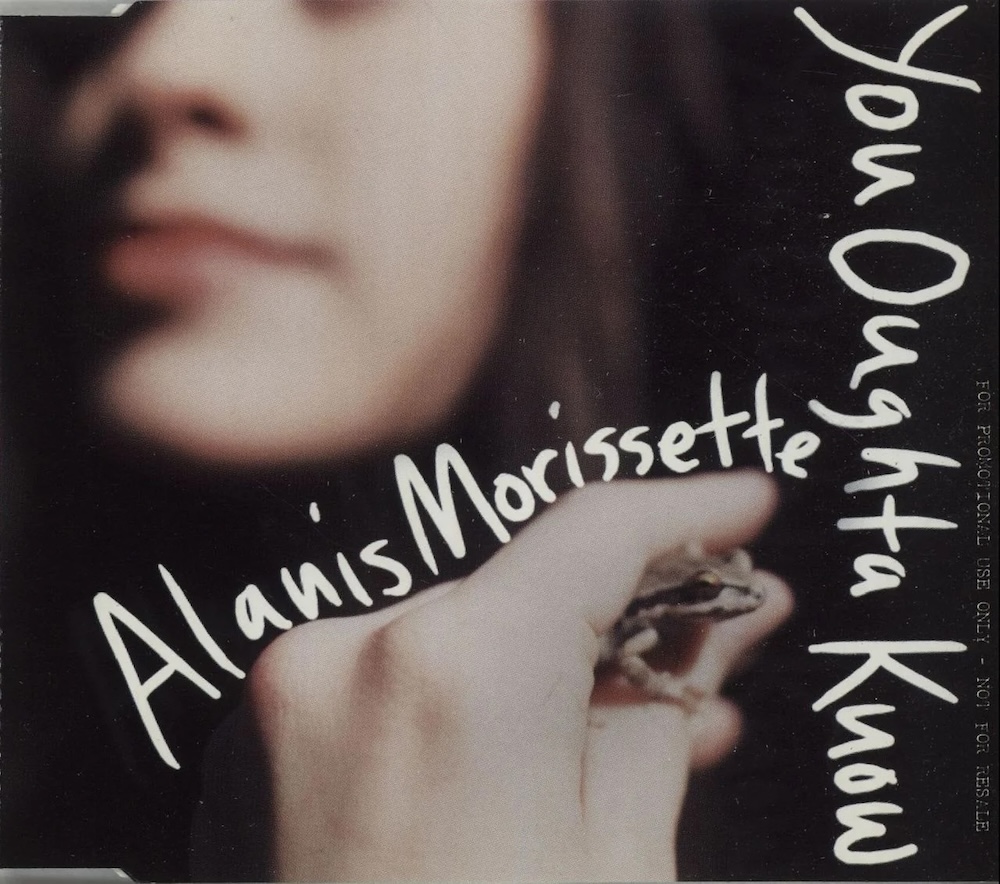
The Alternative Number Ones: Alanis Morissette’s “You Oughta Know”

July 22, 1995

  • STAYED AT #1:5 Weeks

In The Alternative Number Ones, I’m reviewing every #1 single in the history of the Billboard Modern Rock Tracks/Alternative Songs, starting with the moment that the chart launched in 1988. This column is a companion piece to The Number Ones, and it’s for members only. Thank you to everyone who’s helping to keep Stereogum afloat.

Eyyyye whuunt yeeew ta knyeeew that nobody saw this coming. It was one thing to hear "You Oughta Know" on the radio with no context. That made sense. It's a rock song from a lady who is mad at a guy who apparently dumped her and then moved on to somebody else. That's normal. We'd heard that before, and we've heard it more since. "You Oughta Know" belonged to an established category, and it was a really, really good example of its form. The singer had this uncontrolled yodel-howl thing, a bit like Sinéad O'Connor at her most enraged. Her delivery was full of weird little intonations, and all of them were memorable. She sang with real fire, as if she was going through all those emotions right there, in front of you. The chorus was huge. The backing track was funky but not distractingly so. She sang about sex a couple of times, and the first time you listened, you had to pause for a second and wonder if you just heard what you thought you heard. On the radio, those bits was usually bleeped out, but you still knew what she was saying.

The radio is where most people heard "You Oughta Know" for the first time. Not me, though. I came across the song on one of the free CDs that came with issues of CMJ magazine. I just Googled to make sure I didn't make up this memory, but no, it's true. "You Oughta Know" was track 10 of 21 on the disc that came with the July 1995 issue. It's on there with songs from Soul Asylum and Tripping Daisy and Supergrass and the Circle Jerks and Green Apple Quick Step, as well as another song that'll appear in this column soon. But hearing "You Oughta Know" like that wasn't too different from encountering it on the radio. In both cases, Alanis Morissette was merely a name and a song. The song was good. Maybe it was even great. The context stuff all came later, as did the realization that the song was really great.

The context came quickly enough, and it served to make "You Oughta Know" feel even more of a surprise. As in: You mean to tell me that Alanis Morissette was a teenage mall-pop star in Canada until a couple of years ago? And she made this record with the mainstream pop journeyman who produced the Wilson Phillips album? And she's signed to Madonna's label? And a couple of Red Hot Chili Peppers played on this song? And it might be about Uncle Joey from Full House? None of this made any sense. The entire career backstory of young Alanis Morissette was something that your friends from school might make up to see if they could get you to believe it. None of it felt real, but it led up to a song that hit like a meteorite and then kept reverberating for decades.

Thirty years after its release, "You Oughta Know" feels like one of those inexplicable pop miracles -- the right song for the right time, the bullet to the heart of the zeitgeist. When a song hits as hard as "You Oughta Know," it imposes its own logic, and even the most implausible backstory starts to make sense. "You Oughta Know" was a cultural phenomenon, one that went far beyond the confines of alternative rock radio. But alternative rock radio was where "You Oughta Know" first found its audience. We won't get too many opportunities to talk about pop music miracles in this column. We can't take them for granted.

"My name is Alanis! I'm a white chick singer! The drums are a-smokin', and so's the bass!" Those are actual lyrics from "Oh Yeah!," a song from the first Alanis album, which is just called Alanis and which came out on MCA Canada in 1991. I have known about the existence of Alanis for many years, but it has never been in print in the United States, and I'd never thought to even attempt to listen to the record until this moment. But the entire thing is on YouTube, of course, and you can now peruse this fascinating historical document at your own leisure. It kind of goes?

Alanis Morissette was 16 when she made Alanis. She grew up in Ottawa. Her father was French-Canadian, and her mother was born in Hungary; both of them worked in schools for military kids. When Alanis was very young, her family lived in West Germany for a few years while her parents taught at an Air Command base. Young Alanis caught the performing bug after they moved back to Ottawa. When she was 10, she was on a few episodes of the kids' show You Can't Do That On Television. She got slimed. She took the money from that show and used it to record and self-release "Fate Stay With Me," a synthpop single that she wrote. For a few years, she recorded demos, and she performed on Star Search in 1990. Eventually, Morissette got to writing and recording with Leslie Howe, a member of the successful-ish Ottawa synthpop group One To One, whose 1986 single "Angel In My Pocket" made it into the lower rungs of the Hot 100.

One of those demos got Alanis Morissette a deal with MCA Canada, and she and Howe wrote and recorded Alanis together. It came out in 1991, when Morissette was still in high school in Ottawa. It took off right away. "Too Hot," Morissette's debut single, was a #14 hit in Canada, and two more singles made the top 40. The album went platinum in Canada. People always compare teenpop-era Alanis to Debbie Gibson and Tiffany, which makes sense. She's a few years younger than those two singers, and she came along a few years later, so this fits with the general idea that things tend to arrive late in Canada. But when you watch the "Too Hot" video, it's pretty clear that Morissette was styled to look and sound specifically like Paula Abdul, the same way that Paula Abdul was styled to look and sound specifically like Janet Jackson. You can see the Abdul imitation in everything -- the choreography, the leather jacket, the way Morissette's hair was all teased out. But even then, Morissette had her intense, distinctive yowl. In a way, the panting ferocity of her delivery reminds me of early Britney Spears, who would eventually break Morissette's record to become the youngest person ever to record a diamond-selling album.

The music on Alanis is extremely silly, which of course makes me like it more. There's all kinds of equally silly trivia about that part of her career. She opened for Vanilla Ice once, which is fun to think about. She performed in the straight-to-video 1993 movie Anything For Love, and the reason she's in there is to give Corey Haim a chance to pretend to play keyboard in her band. A pre-Friends Matt LeBlanc played the love interest in the video for her song "Walk Away." I guess I probably heard that song when it was new because it was on the Problem Child 2 soundtrack, and I definitely watched that movie at least, like, one and a half times. None of these things exactly presaged titanic alt-rock stardom for young Alanis Morissette, but life is an unpredictable thing.

Alanis Morissette recorded one more album, 1992's Now Is The Time, again co-writing everything with producer Lesley Howe. Her big, boring adult-contempo ballad "No Apologies" made it to #12 in Canada. But where Alanis went platinum, Now Is The Time didn't even go gold. Given that you only have to sell 100,000 records to go platinum in Canada, we aren't exactly talking about astronomical numbers here. Neither album came out in the US, so Morissette never really had any baggage from her teen-pop records down here. After Now Is The Time stiffed, MCA Canada didn't renew her contract. But through the record deal, she also got a deal with MCA's publishing branch, and someone in that publishers' office liked her.

She didn't have a record deal anymore, but Alanis Morissette still had a publisher that was willing to help develop her as a songwriter, which is nice. Morissette's publisher helped her get a manager. After Morissette finished high school, her manager convinced her to move from her parents' Ottawa house to Toronto, where she was terribly lonely. Sometime around then, Morissette briefly dated Full House star Dave Coulier. I have no idea how this happened, and I have found zero explanation online. I figured he must be a Toronto guy, but no, he's American. At the time, Morissette was 17 or 18, and the freshly divorced Coulier was in his early thirties. That's fucking gross! It's also possibly criminal!

The world has generally agreed to believe that "You Oughta Know" is about the end of Alanis Morissette's relationship with Dave Coulier. Coulier himself has both confirmed and denied those rumors. Morissette herself has steadfastly refused to say who she wrote "You Oughta Know" about. She has vowed that she will never say, and at this point, you kind of have to believe her. If she's gone 30 years without saying, she's not going to let it slip in some interview today. She has, however, expressed general befuddlement that anyone would want to take credit for being the guy from "You Oughta Know." So I don't know, maybe it wasn't Coulier. Maybe it was some other chump. People like to imagine Uncle Joey getting a movie-theater blowjob because it's a funny image, at least until you consider the respective ages of the people involved. But the identity of the guy really isn't the point of the song, is it?

In Toronto, Morissette went looking for a new songwriting collaborator, and she had no luck for a while. Eventually, she started taking trips to Los Angeles and meeting with prospective writing partners when her publishers set her up with them. On one of those trips, she met Glen Ballard, someone who'd had huge success a few years earlier but who didn't fit into the '90s pop landscape in any obvious ways. Ballard, a Mississippi native, came into the music business as a protege of Quincy Jones. In the early '80s, he wrote songs for the Pointer Sisters, soap opera star Jack Wagner, and young country prospect George Strait. Ballard has been in the mainline Number Ones column for co-writing Michael Jackson's "Man In The Mirror" and for producing all three of Wilson Phillips' chart-toppers. But Wilson Phillips' Ballard-produced 1992 sophomore album Shadows And Light flopped, so Ballard really didn't have that much going on when he met young Alanis Morissette in 1994.

For whatever reason, Alanis Morissette and Glen Ballard clicked perfectly. Within a few hours of meeting each other blind, the two of them wrote and recorded their first song together. Ballard tells the story in a 2015 Stereogum interview, though I'm sure he's told the same story plenty of other times in plenty of other places. Ballard told Morissette about the Bottom Line, the New York club where songwriters would showcase their wares, and that led to the two of them writing "The Bottom Line," a song that isn't really about the club, except in a play-on-words kind of way. "The Bottom Line" didn't find its way onto the Jagged Little Pill album, but it was a bonus track on a 20th-anniversary reissue. Pretty good song!

Morissette was just about to turn 19 when she met Glen Ballard, and she kept going back to Los Angeles to write more songs with him. They set themselves a goal: They would write and record a new song every day that they worked together. In 20 sessions, they wrote 20 songs together, and 12 of those songs eventually became Jagged Little Pill. In that time, Morissette went back and forth between LA and Toronto. She and Ballard wrote "You Oughta Know" in October 1994, after taking a break from writing for a few months. Morissette was reportedly nervous about singing the words that she'd written, but Ballard encouraged her. Eventually, after working away at the song for an entire day, Morissette belted it out once, late that night, and Ballard recorded her.

Lots and lots of things changed from that song's original demo, but the vocal on "You Oughta Know" is the one-take version that Morissette recorded on the night that she and Ballard wrote the song. You can tell. She couldn't sing like that if she had any distance, any perspective. In a lot of ways, "You Oughta Know" is an extremely immature song. It's about refusing to move on, about being unwilling to accept the idea that this other person's life continues without you being in it. That's why it works. That's the power. Alanis Morissette is a thoughtful, articulate human being, but "You Oughta Know" is thankfully not a thoughtful, articulate song. It's a convulsive unburdening, a howl at the moon. It works as pop music because it's made by two pop professionals, people who'd put in enough work that craft became second-nature. Morissette doesn't sing "You Oughta Know" like she's trying to make a hit, which is probably exactly why it became a hit. It's not calculated. It's instinctive.

There's a version of the "You Oughta Know" demo on YouTube, but it honestly seems too shitty to be real. I'm guessing it's not. I'm guessing that someone just put the Alanis vocal over some bullshit. Maybe we'll never hear the demo version, and that's fine. The vocal is enough. It's an absolutely crazy vocal. From the track's very first words, Morissette sings everything in a berserk yodel-growl, even when she's trying to be quiet and contained. People have been doing unflattering impressions of her delivery for decades, but I fucking love it. All of her odd techniques -- the audible intakes of breath, the way she emphasizes certain syllables and twists certain vowel sounds into new shapes, the dropped consonants at the ends of words -- drill their way into your memory. When you sing along to "You Oughta Know," an extremely fun thing to do, you can't help but do at least a little bit of an Alanis impression. The delivery is stamped upon the words and the melody.

Morissette's "You Oughta Know" lyrics got a lot of attention in 1995, and you can see why. This was still the era when rappers weren't cussing on their crossover pop songs, when Stevie Wonder refused to license the "Gangsta's Paradise" sample unless Coolio took out all the cusswords. Radio stations always bleeped the "fuck" on "You Oughta Know," but you could still understand Morissette perfectly, to the point where you might hallucinate that you'd actually heard the word. Or maybe your radio station did leave the "fuck" in; who am I to say? To her great credit, Morissette has never taken the "fuck" out of "You Oughta Know" when performing live, even when she's singing at the Grammys or whatever. If someone else wanted to bleep it, they could do it themsleves. Also, the concept of oral sex in movie theaters wasn't really part of 1995 mainstream discourse. At least, I hope it was oral sex in a movie theater, though she leaves the word "movie" out. I hope Morissette wasn't giving anyone a blowjob at a play. The actors could see them! It would be quite distracting!

But the sex stuff on "You Oughta Know" doesn't feel like it's there for shock appeal. Morissette doesn't deadpan those lines, the way Liz Phair did on "Flower" a couple of years earlier. When you break up with someone, one of the hardest things is imagining them fucking someone else -- or, worse, being happy fucking someone else. You want that person to look back and realize that you're better at sex than whoever they're with now. That's got to be a universal thing, right? The sex is part of the feeling of betrayal, but it's not the whole thing, and it's not the only thing that Morissette sings about. It's just a starting point. She gains more steam when she demands to know whether she can be so easily replaced. This guy couldn't be vulnerable and open with you, but he can do it with her? Fuck that shit!

In the song's opening moment, when Alanis Morissette insists that she is happy for this guy and his new relationship, she doesn't sound remotely sincere. Her voice drips icy sarcasm, and then it gets worse. She becomes progressively more confident and pissed off at roughly the same rate, until she's almost post-verbal. The title is almost a red herring. This person doesn't oughta know anything. He just has to feel it. The coldest accusation of the entire song is this one: "But you're still alive!" Your continued existence is an affront to Alanis Morissette. She's so offended that she cannot bear it.

While Alanis Morissette and Glen Ballard were writing these songs together, Ballard took the demos around to different labels. At first, nobody was interested. Finally, though, they found their way to Maverick Records, the Warner imprint that Madonna co-founded in 1992. Madonna didn't sign Morissette, though. Instead, the person who made that call was her A&R guy Guy Oseary, who was still in his early twenties, only a couple of years older than Morissette. He made a very good decision. Jagged Little Pill, Morissette's album, sold more copies -- like, a lot more copies -- than any Madonna record.

Alanis Morissette and Glen Ballard brought in session musicians to flesh out their original demos. Benmont Tench, the keyboardist from Tom Petty's Heartbreakers, came in to play on a bunch of Jagged Little Pill, tracks, "You Oughta Know" included. Ballard still played a bunch of the instruments on the record -- guitar, keyboard, drum programming. The drums on "You Oughta Know" sound a bit like they're programmed; they've got that syncopated breakbeat thing happening. They're actually played by Matt Laug, a longtime session guy who later became another of Petty's Heartbreakers. Right now, Laug serves as AC/DC's touring drummer.

Originally, "You Oughta Know" had a different guitarist and bassist. Guy Oseary clearly thought the song had hit potential, since he's the one who suggested recruiting a couple of alt-rock aces to play on the track. Dave Navarro has already been in this column a couple of times for the stuff he did in Jane's Addiction. In 1993, he joined the Red Hot Chili Peppers, a group that's been in this column twice already. At some point in the making of Jagged Little Pill, Navarro and his new Chili Peppers bandmate Flea came in to play guitar and bass, respectively, on "You Oughta Know." They threw out the stuff from the song's previous version; Flea in particular has said that the playing on the original version was "some weak shit." The two of them played around with the arrangement and replaced it with some shit that was not weak at all. They didn't play on any other Jagged Little Pill songs, just that one.

When "You Oughta Know" was new, I don't think I realized that Flea was playing bass on the song. But once you hear his contributions, you can never unhear them. Flea gets busy on the track, especially during the pre-chorus. There's just a whole lot of bass-popping happening on there -- riffs, stabs, occasional blurts that almost work as exclamation points for Morissette's lines. One might even argue that there's too much bass-popping, though it never takes away from the primal force of the song. Dave Navarro, by contrast, keeps things at a low boil, doing a cool mechanical fuzz-wash thing that doesn't sound too much like what he has done in his various different bands. In different ways, both Flea and Navarro serve the song, and I think it's to their credit that they never grab the spotlight away from the relatively untested Morissette. "You Oughta Know" might've been a for-hire job for those guys, but off the top of my head, I can't think of a better song that Flea has played on over his very long career. Young MC's "Bust A Move," another for-hire job, is the only real competitor I can think of. Sorry, Atoms For Peace. (The Flea/Navarro version of the Chili Peppers will appear in this column soon enough.)

Alanis Morissette was a total unknown in the US when Jagged Little Pill hit stores in June 1995, and nobody at Warner had huge commercial expectations for the record. But then KROQ in Los Angeles started playing "You Oughta Know," and alt-rock stations across the country followed suit. Before I knew it, that song I'd heard on the CMJ CD was on the radio once an hour. Morissette wasn't an obvious candidate for alt-rock play. Maybe the presence of Flea and Dave Navarro was enough to interest alt-rock programmers, but I think it was mostly just the song itself, which stood out even if you knew none of the credits. This was just after Sheryl Crow, another artist with an extremely unlikely backstory, broke through on alt-rock radio and then crossed over to wider audience. That's what Morissette did, too. She had pop ambitions, pop sweep, and pop melodies, but she sang "You Oughta Know" with such fevered intensity that the song fit into the post-grunge modern rock landscape about as well as anything else.

The Alanis Morissette/alt-rock connection was still pretty tenuous, though. In a 1995 SPIN cover story, Morissette admitted that she'd never even heard PJ Harvey, the greatest critical darling of that moment. Critics never fully got behind Morissette. On the 1994 Pazz & Jop poll, Harvey's To Bring You My Love came in at #1, while Jagged Little Pill charted way down at #32, between Dione Farris' Wild Seed - Wild Flower and Guided By Voices' Alien Lanes. I'm not going to sit here and tell you that Jagged Little Pill is somehow better than To Bring You My Love. It's not. But I do think a culturally seismic record deserves a little more consideration than that. On the singles poll, "You Oughta Know" did better. It tied with Edwyn Collins' "A Girl Like You" to come in at #2, behind the aforementioned "Gangsta's Paradise." (On the Modern Rock chart, "A Girl Like You" peaked at #7. It's a 9. Harvey's highest-charting single, 1995's "Down By The Water," peaked at #2. It's a 10.) In any case, Alanis Morissette wasn't really for the critics. She was the people's champ.

A couple of years later, "You Oughta Know" would not have had the chance to break through on alt-rock radio, and Morissette would've had a much tougher time becoming the people's champ. After the 1996 Telecommunications Act, Clear Channel started buying up radio stations all across America and imposing top-down playlists on them. Alternative rock programmers laser-targeted young white men, and they played songs that seemed guaranteed to appeal to that demographic. Not coincidentally, women virtually vanished from the alt-rock airwaves, which means that they'll virtually vanish from this column pretty soon, too. In 1995, however, a song like "You Oughta Know" could still spread from one station to the next. MTV helped, too. Alanis Morissette and director Nick Egan shot the clip in Death Valley. It's nothing exceptional, just Morissette rocking out with the rocker dudes in her backing band, but it looked cool enough, and it put a face to the name and the voice. (Future Foo Fighter Taylor Hawkins played drums in Morissette's band when she toured behind Jagged Little Pill, but I don't think he's the drummer in the video.)

"You Oughta Know" spread quickly. A month after it first appeared on the Modern Rock charts, it climbed all the way to #1. Before long, the song was getting heavy play on mainstream rock and pop stations, too. "You Oughta Know" would've probably done some serious damage on the Hot 100 if Maverick had released it as a retail single, but the label never did. Eventually, Maverick put a live version of "You Oughta Know" on the "You Learn" CD single, and that's probably a big part of the reason that "You Learn" made it to #6 on the Hot 100. (On the Modern Rock chart, "You Learn" peaked at #7. It's a 7.)

"You Oughta Know" became a huge pop hit around the world, but Maverick was probably smart not to release the song as a single in the US. Instead of buying the single, people bought the Jagged Little Pill album in great numbers. A few months after its release. Jagged Little Pill was platinum. In October, it dethroned Hootie & The Blowfish's Cracked Rear View to become the #1 album in America. By that time, Alanis Morissette has another song in radio rotation. We'll see her in this column again soon.

GRADE: 10/10

BONUS BEATS: God, there's so much I could do with this section. "You Oughta Know" is the kind of song that never goes away. Virtually every important female pop star of the past few years has sung "You Oughta Know" at some point. Britney Spears and Beyoncé have covered it. Alanis Morissette has herself performed it with Taylor Swift and Olivia Rodrigo, among others. The Curb Your Enthusiasm bit? The Booksmart karaoke scene? I could embed about a million videos in this section, but that would break this website. So instead, I'm going with the Bonus Beat that's most alive in my memory, and that's Kate Winslet screaming along to "You Oughta Know" while speeding across the Australian desert in Jane Campion's 1999 film Holy Smoke. I love this scene:

THE NUMBER TWOS: The aforementioned Foo Fighters' debut single, the turbo-charged power-pop rager "This Is A Call," peaked at #2 behind "You Oughta Know." It's an 8.

THE 10S: Weezer's "Say It Ain't So," the elliptical jangle-funk enigma that builds into a chest-thumping power-chord singalong enigma, peaked at #7 behind "You Oughta Know." It awakens ancient feelings, and it's a 10.

Elastica's "Stutter," a revved-up new-wave pogo anthem about erectile dysfunction, peaked at #10 behind "You Oughta Know." It's a 10, or else you can tie me to the traaaaacks.

GET THE STEREOGUM DIGEST

The week's most important music stories and least important music memes.