Skip to Content
Columns

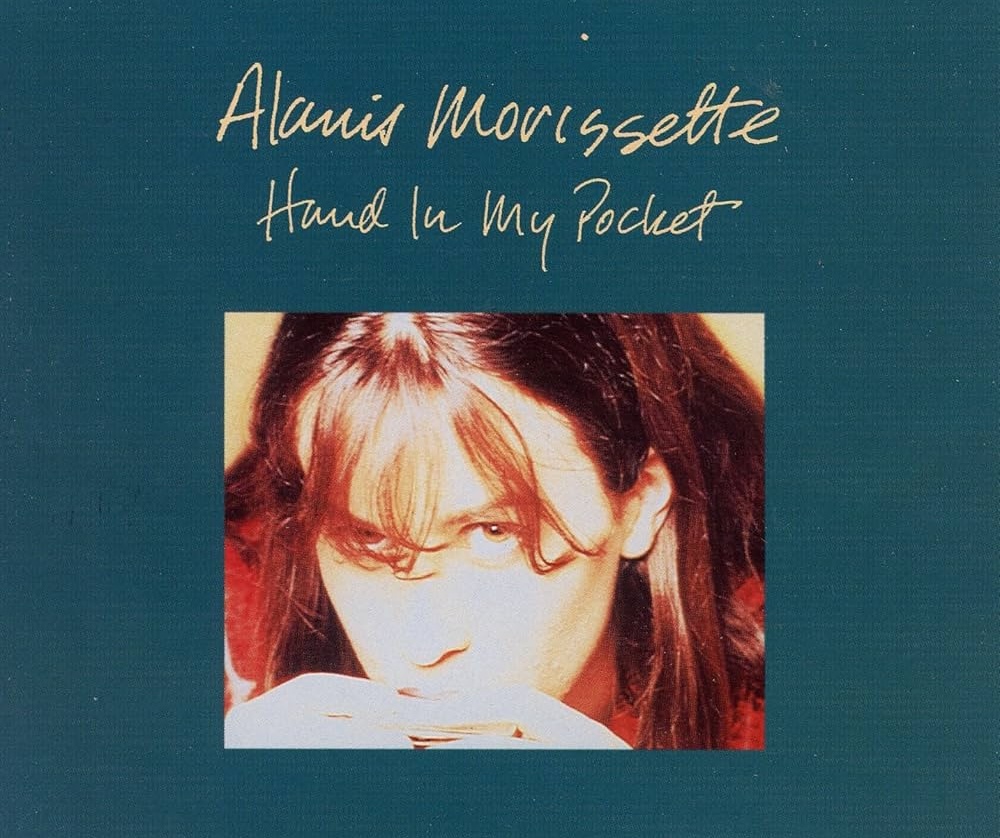
The Alternative Number Ones: Alanis Morissette’s “Hand In My Pocket”

October 14, 1995

  • STAYED AT #1:1 Week

In The Alternative Number Ones, I’m reviewing every #1 single in the history of the Billboard Modern Rock Tracks/Alternative Songs, starting with the moment that the chart launched in 1988. This column is a companion piece to The Number Ones, and it’s for members only. Thank you to everyone who’s helping to keep Stereogum afloat.

In the movie Lady Bird, there's a scene where the title character gets a ride to school from her dad, and they listen to Alanis Morissette's "Hand In My Pocket." Saoirse Ronan, playing Lady Bird, asks her dad, "Did you know that Alanis Morissette wrote this song in only 10 minutes?" Tracy Letts, as her dad, deadpans back, "I believe it." That's good shit. That's a set and a spike. Dads everywhere prowl the earth, just waiting for our kids to say something enthusiastic about some annoying shit that they like -- something that we can volley back in the pithiest, most undemonstrative manner. We live for that shit.

I get why Lady Bird's dad was not impressed by the level of work that went into "Hand In My Pocket." The song isn't about anything. It's just Alanis Morissette singing that she's something but something else, she's one thing but one other thing, she's an adjective but an unrelated adjective, bayyyy-beh. She's got one hand in her pocket, and the other hand is doing some fucking thing, who knows. You can make up your own version. The sets of adjectives don't even have to contradict each other. I'm tall, but I'm sleepy. I'm hungry, but I'm getting old. I'm bored, but I have to pee, yeah-eah. I've got one hand in my pocket, and the other one's writing an Alternative Number Ones column.

Alanis Morissette once said that "Hand In My Pocket" is about "dichotomies and dualisms" -- all the ways in which human beings are not so easy to categorize. This is perfect fake-deep thinking. Nobody is going to have their mind blown by these insights. And anyway, none of her dichotomies or dualisms really work in opposition to one another in any substantive way. If you have lived on this planet for more than a handful of years, you will not be surprised to learn that a person can be sad but laughing, brave but chickenshit, sick but pretty, bayyyy-beh. It's just part of the deal.

"Hand In My Pocket" could not exist unless it was written by a very young person in a very short period of time. Nobody else would bother to put those thoughts to paper or to record them for all eternity. Anyone who did write those words would probably delete them if given any time to revise. That's part of the magic of the song. It's not that Alanis Morissette reveals some great secret universal truths to us. It's that she's learning this stuff herself, finding meaning in something that other people would dismiss as nothing but diary scribbles, and then translating it into sharp, sticky pop music. And anyway, Lady Bird is wrong. Alanis Morissette did not write "Hand In My Pocket" in ten minutes. She wrote it in fifteen.

Depending on who you ask and when you ask it, it might've even taken Alanis Morissette a full hour to write "Hand In My Pocket." Point is: She did it quickly. At that point, Morissette was still an unsigned ex-child star from Canada who was a total unknown in these United States. She and Glen Ballard, the pop mastermind who'd helped turn Wilson Phillips into a moneymaking proposition a few years earlier, were still writing songs together. During one writing session, she jotted down a bunch of juxtaposed emotional states while Ballard was out of the room, and then she read them back to him when he returned. He started playing a melody on guitar, and they knocked a song together quickly. When the two of them wrote "You Oughta Know" during those same writing sessions, Morissette really had to dig something out of herself. That was not the case with "Hand In My Pocket." "Hand In My Pocket" was easy breezy.

In 2021, Morissette wrote the foreword for No Bad Parts, Richard Schwartz's book about Internal Family Systems therapy. My wife is a therapist, and that's the kind of therapy that she does, so I have at least the barest idea of what that means. It's about talking to the different parts within yourself, resolving them and making peace with them. I haven't been to a lot of therapy, but one of the things you have to do -- something that felt weird and hard for me -- is to constantly check in with yourself and figure out how you're feeling at any given moment. I'm not used to that self-examination. I generally don't even realize I'm upset about something until I start acting like a dick about it. On some level, then, Morissette's "Hand In My Pocket" lyrics are pretty advanced, psychologically speaking. She recognized and celebrated different parts of herself, parts that could've been seen as being in opposition to one another, years before IFS therapy existed. That's one read on those lyrics, anyway.

But nobody really needs to read those lyrics too deeply. It's not necessarily an epiphany to realize that you're broke but you're happy, you're poor but you're kind, etc. Does the one hand in Alanis Morissette's pocket represent her inner drive to shrink into herself, to isolate, while the hand giving a high-five or peace sign is her more outgoing, extroverted side? Or is she just literally describing what she's doing at any given moment? If she had a hoodie with a pouch, would her one hand be in that, instead? Who cares? I think "Hand In My Pocket" works in spite of the lyrics, which are silly and surface-level though not uncharming. When she wrote her parts of that song, Morissette was a teenage girl talking about her own feelings. That can be fun or tedious, depending on lots of factors. Most of the time, though, it doesn't translate into an alt-pop gem.

"Hand In My Pocket" is an alt-pop gem, or really more accurately a straight-up pop gem. There's no explosive rage, the way there was on "You Oughta Know." Glen Ballard didn't bring in heavy-hitter musicians like Flea and Dave Navarro to play on "Hand In My Pocket," either. Instead, he looped up some drums and played a contemplative, ringing guitar line and some soft-humming keyboard bits over it. I like the burbling synthetic bassline and the vaguely churchy organ on the track. That's all Glen Ballard. Once he programmed the drum machines, he tried bringing in an actual drummer to play on the track, but it didn't sound quite right. So every instrument on "Hand In My Pocket" is just Glen Ballard, except for the harmonica. The harmonica is Alanis Morissette. As with "You Oughta Know," the "Hand In My Pocket" vocals on Morissette's Jagged Little Pill album are the demo ones that Morissette recorded on the day that she and Ballard wrote the song.

The tossed-off quality really works for "Hand In My Pocket." The groove is almost trip-hop, but it has no connection whatsoever to actual rap music. The guitar chords rise up and fade away at right moments. Ballard's arrangement goes straight for pleasure centers, never trying too hard to sound sweet or disruptive. Alanis Morissette's fevered yowl is just as strong on this song as it is on "You Oughta Know," but she radiates very different emotions. She sings that everything's gonna be quite all right, and she sounds like she believes it. I hear a glow of chilled-out optimism coming from her that I don't hear from anyone today.

Just like "You Oughta Know," "Hand In My Pocket" was on the demo tape that Morissette and Ballard shopped around to record labels. When Guy Oseary at Madonna's Maverick imprint heard it, he was sold. "You Oughta Know" was the rocketship that made Morissette hugely popular almost immediately, but it was didn't really sound like anything else on Jagged Little Pill. While that song was bubbling, Morissette's various handlers and label people figured out how to continue presenting her to the world. Jagged Little Pill was already double platinum by the time that Morissette launched "Hand In My Pocket" as its second single. If I had to guess, I'd say that "Hand In My Pocket" was chosen as a single to correct the public's idea of Morissette, in some ways -- to give a better idea of who this artist actually was.

When "You Oughta Know" blew up, a lot of Morissette's press revolved around the "angry woman" trope. People loved talking about '90s alt-rock through that lens. I remember being genuinely surprised when Morissette told SPIN that she'd never actually listened to PJ Harvey, but it makes total sense in retrospect. She just wasn't making the same kind of music. The vast majority of Morissette's songs weren't about being angry at all. They were lightly philosophical, inward-looking singer-songwriter joints with big, catchy hooks. "Hand In My Pocket" works on its own, and it also gives a more representative sample of the person who sings it.

When Jagged Little Pill came out in June 1995, Alanis Morissette put together a band and went out on the road. Her bandmates all came from the LA alt-rock world. Guitarist Jesse Tobias was very briefly a Red Hot Chili Pepper before Dave Navarro joined the band; he later became Morrissey's main collaborator. Bassist Chris Chaney will eventually appear in this column as Eric Avery's replacement in the reunited Jane's Addiction. The late drummer Taylor Hawkins will be in here, too, as a Foo Fighter. In the first SPIN cover story about Morissette, Hawkins described himself as a "cross between Brad Pitt and Animal." I really don't think anyone should talk about themselves that way, even if it's sort of accurate in this case. Morrisette told SPIN, "If I wasn't in a band with them, I would probably have dated each one of them already, except Nick [Lashley, the other guitarist], who's married. But it's too sacred for us to jeopardize our professional relationship."

Morissette filmed the "Hand In My Pocket" video in Brooklyn during a very busy week in New York in September 1995. She was there to play some critic-heavy shows, to perform on Letterman and at the VMAs, and to do a fuckton of interviews. Sometime in there, she linked up with Mark Kohr, Green Day's go-to director. Kohr staged a parade for the express purpose of making that clip. Morissette had the basic idea. She wanted to be in a parade -- not as a focal point, but as the person who drives the car with the beauty queen in back. Kohr surrounded her with arresting-looking extras, filming everything in high-contrast black and white. Morissette looks beatific in a way that matches the song nicely. I like the shots where she's at the center of the frame, standing motionless as people move all around her, sometimes in the pouring rain. She gives off the vague sense that she likes people. You might not get that from "You Oughta Know."

That warmth came through in the song, too. I definitely thought "Hand In My Pocket" was cheesy when I was 16, and I probably tried to convince myself that I didn't actually like it. But it was just too sweet and good-natured to rankle me in any real way. Those hooks really hit, too. It's probably worth asking what makes a song like "Hand In My Pocket" alternative, and you could ask the same about a lot of other stuff in alt-rock radio rotation at the time. The format was in an ongoing post-grunge identity crisis, and I liked "Hand In My Pocket" a lot better than the Nerf grunge of Silverchair and Bush. The song effectively reframed Morissette as the singer-songwriter that she always was, and singer-songwriter stuff was getting play on alt-rock stations at the same time. During the one week that "Hand In My Pocket" topped the Modern Rock chart, plenty of like-minded stuff was in the mix: Heather Nova, Natalie Merchant, Lisa Loeb, Joan Osborne, maybe even Blues Traveler and the Dave Matthews Band. The Lilith Fair kicked off two years later. Alanis Morissette never played that festival, but she definitely helped set the stage for it.

Jagged Little Pill first reached #1 on the US album chart in October 1995, around the same time that the "Hand In My Pocket" single came out. "Hand In My Pocket" also got play on pop and mainstream rock stations, though it never made the Hot 100 because a commercial single never came out in the US. In Canada, the song was a #1 pop hit. Morissette sang it in her first Saturday Night Live appearance that October. (The host was Gabriel Byrne, I guess because of The Usual Suspects?) Morissette's album opener "All I Really Want," a truly kickass song, started getting modern rock airplay right around then even though it never got a video or a proper push, and it reached #14. The album continued to sell in wild, staggering numbers.

In February 1996, Jagged Little Pill won Album Of The Year at the Grammys, defeating records from Michael Jackson, Mariah Carey, Pearl Jam, and Joan Osborne. Morissette also took home three other awards, becoming the night's top winner. (Those other awards were all in the rock categories, no the pop or alternative ones.) By that time, Jagged Little Pill was sextuple platinum, and it was really just getting started. Another Jagged Little Pill song was still in the process of taking off, and it's probably even more famous than "You Oughta Know" now. When that song makes its way to #1, we'll see Alanis Morissette in this column again.

WHAT IT ALL COMES DOWN TO, MY FRIEND: 7/10

BONUS BEATS: Here's the strange, didgeridoo-laced "Hand In My Pocket" cover that the soothing Australian TV painter Rolf Harris released in 1997:

BONUS BONUS BEATS: Here's Jamaican dancehall star Beenie Man riffing on "Hand In My Pocket" on his incredibly strange 1997 country song "Ain't Gonna Figure It Yet":

BONUS BONUS BONUS BEATS: Before it went to air, the 1998 pilot episode of Dawson's Creek used "Hand In My Pocket" as its theme music. But when the fledgling WB network picked Dawson's Creek up, Alanis Morissette wouldn't clear the song, so Paula Cole's "I Don't Want To Wait" got plugged in there instead. Here's a reconstructed look of how that Dawson's Creek opening might've looked:

(Paula Cole's only Modern Rock hit, 1997's "Where Have All The Cowboys Gone," peaked at #32.)

BONUS BONUS BONUS BONUS BEATS: Here's Judith Light singing a teary cabaret rendition of "Hand In My Pocket" as part of a one-woman show in a 2016 episode of the memory-holed Amazon show Transparent:

GET THE STEREOGUM DIGEST

The week's most important music stories and least important music memes.