
- Roc Nation
- 2016
Rihanna cranked out her first seven studio albums in just as many years. In 2026, there’s quantifiable evidence that the Barbadian artist has an unshakeable work ethic — just spend 30 seconds in a Sephora or scrolling Instagram ads — but when I think about Rihanna’s discography, I think about the teenage girl who Jay-Z signed to Def Jam on the spot. I think about how she was barely old enough to drive in the United States when she moved here from Barbados, and how she was only 19 when she began recording her aptly-titled “grown up” album Good Girl Gone Bad. I think about the chaos that ensued among fans when 2013 came and went without a new Rihanna album, marking only the second Rihanna-less calendar year since 2005. I think about how even having to testify in a domestic violence case didn’t derail that streak. I tend to withhold pity for the uber-wealthy, but I do think it was a small miracle that Rihanna didn’t burn out from music sooner.
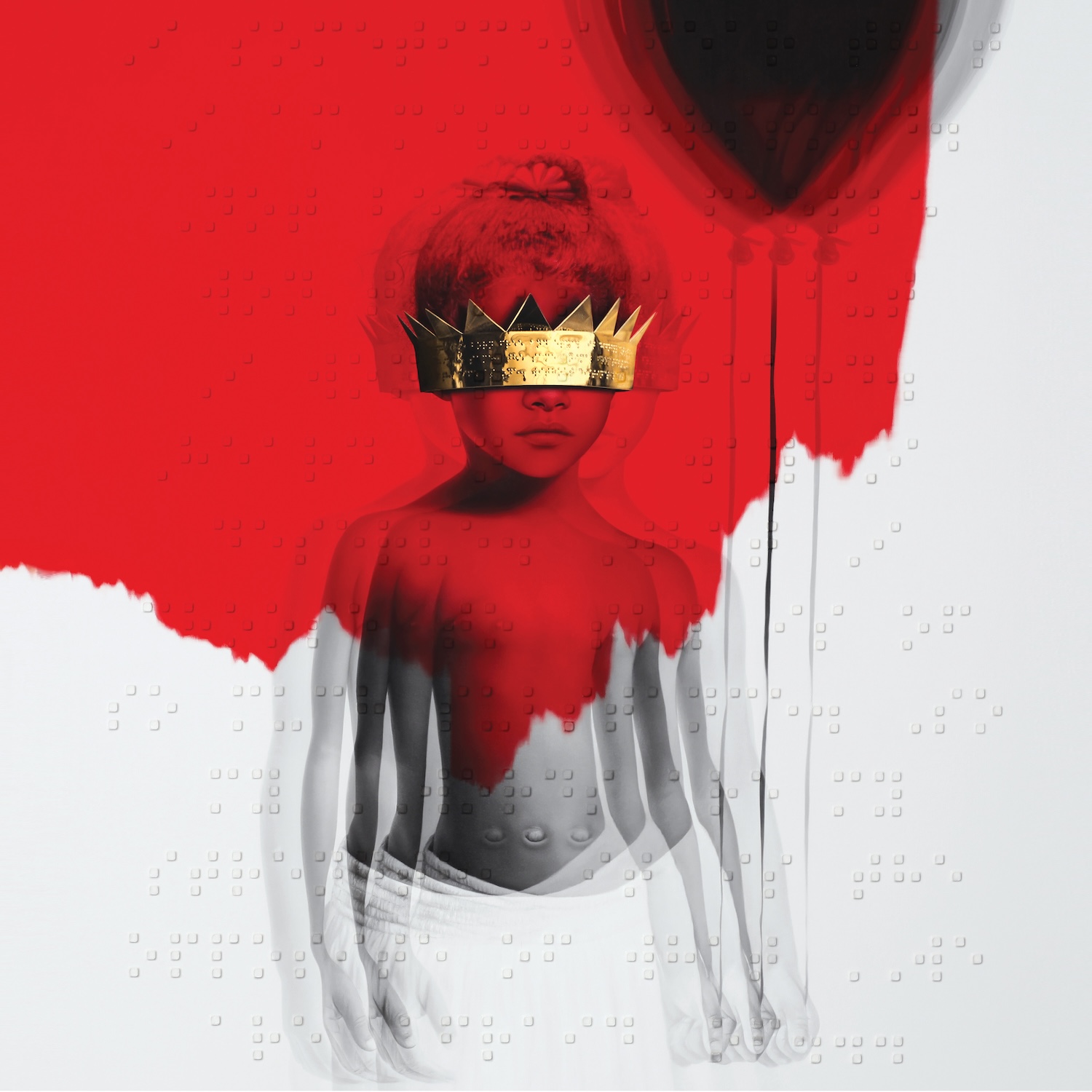
I think Rihanna needed to make Anti, which turns 10 years old today, although it was a bit of a bumpy ride to get to her eighth studio album. She followed Jay-Z to Roc Nation, and across 2015 she released three vastly different singles: “FourFiveSeconds" with Kanye West and Paul McCartney, "Bitch Better Have My Money,” and "American Oxygen." She celebrated 4/20 that same year by releasing “James Joint,” a funky interlude where she admits that she’d “rather be smoking weed whenever we breathe,” on her website before it was removed not long after. That October, she and artist Roy Nachum hosted an event at Los Angeles’ MAMA Gallery to reveal the title and cover art of Anti. Nachum’s painting of a young Rihanna wearing a crown is layered with a poem she co-wrote with Chloe Mitchell, reading in part: “My voice is my suit and armor, my shield, and all that I am.” No new music was played at the event.
Finally, in the days leading up to Anti’s scheduled release date, Kanye West stepped down as its executive producer for unknown but now-fortunate reasons. In the final preceding hours, instead of just its official lead single “Work,” the whole album was leaked on Jay-Z’s then-burgeoning Tidal. It was a chaotic album rollout for a project that also felt a bit incohesive upon release, something Rihanna herself likely sensed: “I went through so many emotions and roller coasters of feeling good, loving it, hating it, doubting myself, hating myself,” she said at the time. “‘This is awful.’ ‘I lost it.’ ‘Wait, but I do love it still...’ Eventually you just need to know who you are. You know when something is you.”
It’s remarkably appropriate that Anti opens with the SZA duet “Consideration,” the song Rihanna herself has said best encapsulates the album’s essence. Over a pared-down instrumental that feels equal parts indebted to classic dub and the art-pop of ”Venus As A Boy,” Rihanna alludes to the growing pains that come with having your star cemented at such a young age: “I got to do things my own way, darling/ You should just let me/ Why you ain’t ever let me grow?” Like quite a few moments on Anti — “James Joint” included — it’s a little on-the-nose, but I can’t blame Rihanna for feeling like that might be the most effective way to get her message across. The absence of a shoo-in radio hit like “Pon De Replay,” “Umbrella,” or “Only Girl (In The World)” was deliberate, and made room for Rihanna to act on her creative whims with a laundry list of notable personnel: “I take risks because I get bored,” she said then. “And I get bored very easily… My thoughts never bore me.”
But because the world remains infatuated with Rihanna, Anti did spawn hits, three of which cracked the Hot 100 Top 10: The doo-wop facsimile “Love On The Brain,” the hazy Mustard-produced “Needed Me,” and the relatively understated, Drake-featuring “Work,” which went to #1 in spite of Rih’s patois embellishments and unabashedly Barbadian delivery. An early Anti review somewhat heedlessly described “Work”’s lyrics as “post-language,” a sentiment to which Rihanna shrugged: “That’s how we speak in the Caribbean. It’s very broken and it’s, like, you can understand everything someone means without even finishing the words.”
Anti didn’t need to make sense to anyone else; it only needed to make sense to Rihanna. That’s why Extreme guitarist Nuno Bettencourt shreds over the trap percussion of “Kiss It Better”; why the “Never Ending” goes full acoustic-folk mode; why the record closes with the balladic one-two punch of the dazzling “Higher” and the piano-backed “Close To You”; why there’s a full-on Tame Impala cover co-signed by the guy himself. Between those moments are songs like “Woo,” a Travis Scott-featuring Weeknd co-write that sounds almost sinister, and “Yeah, I Said It,” where Timbaland makes a beat better suited for the bedroom than the club.
If there is one common thread through Anti besides Rihanna’s laissez-faire attitude towards it, it’s the messy stages of post-breakup grief, from the razor-sharp dismissal of "Needed Me" to the cautious optimism of “Never Ending.” That jadedness is perhaps best depicted on the psych-rock influenced “Desperado,” which puts Rihanna at the center of her own fucked up Wild West odyssey: “If you want, we can be runaways/ Running from any sight of love,” she sings. “There ain't nothin' here for me anymore.”
A few years after Anti’s release, Rihanna alluded to having gone through a “really hard time” while making it: “I felt like maybe I had disappointed god so much that we weren’t as close,” she said in 2019, a somewhat shocking statement coming from the woman who swore against becoming a role model. “[My faith] wasn’t even lost then. The devil just has a way of making you feel like you’re not good enough.” She didn’t elaborate much further. In the years surrounding Anti, Rihanna kept the majority of her personal life close to her chest: She’d roll her eyes when asked about her off-again, on-again partner Drake, or go conspicuously quiet at the mention of ex Travis Scott. She was single, she claimed when Anti came out, but only because she was too busy to handle a relationship. She juggled a handful of acting projects between tours, and positioned herself as a business mogul by launching Fenty Beauty, her lingerie brand Savage X Fenty, and the now-defunct ready-to-wear line Fenty in 2017, 2018, and 2019 respectively. Then Rihanna’s priorities shifted yet again.
Rihanna began dating ASAP Rocky, the father of her three children, in 2020. Each of their pregnancies was announced with fanfare: First came a stunning photoshoot in the New York snow, then a jaw-dropping Super Bowl Halftime Show performance, then a walk along the Met Gala red carpet. Over time, hope of Anti’s follow-up has diminished to Sky Ferreira levels of improbability, even once donning a possibly-not-ironic “I’m Retired” t-shirt in front of paparazzi cameras. She’s hinted at a return to the studio as recently as last year, but aside from being a featured artist on a few singles from friends like DJ Khaled, the only new music we’ve heard from Rihanna since Anti has been for presumably lucrative movie soundtracks.
I don’t think it’s a tragedy if Anti ends up being the last album Rihanna ever releases. A decade in hindsight, the album’s inconsistencies feel more like purposeful eclecticism, and its hits function on their own while serving crucial purposes in the context of the record. “Love On The Brain” at the karaoke bar, for one, feels a lot more carefree than “Love On The Brain” following “Desperado” and “Needed Me.” Anti is daring, multifarious, and sometimes strange, as is the woman behind it. Ahead of the album’s release, she said its title referenced “a person opposed to a particular policy, activity or idea.” Anti doesn’t get quite that philosophical, but it does make clear exactly what Rihanna is standing for: herself. That’s not such a bad way to go out.