Skip to Content
The Alternative Number Ones

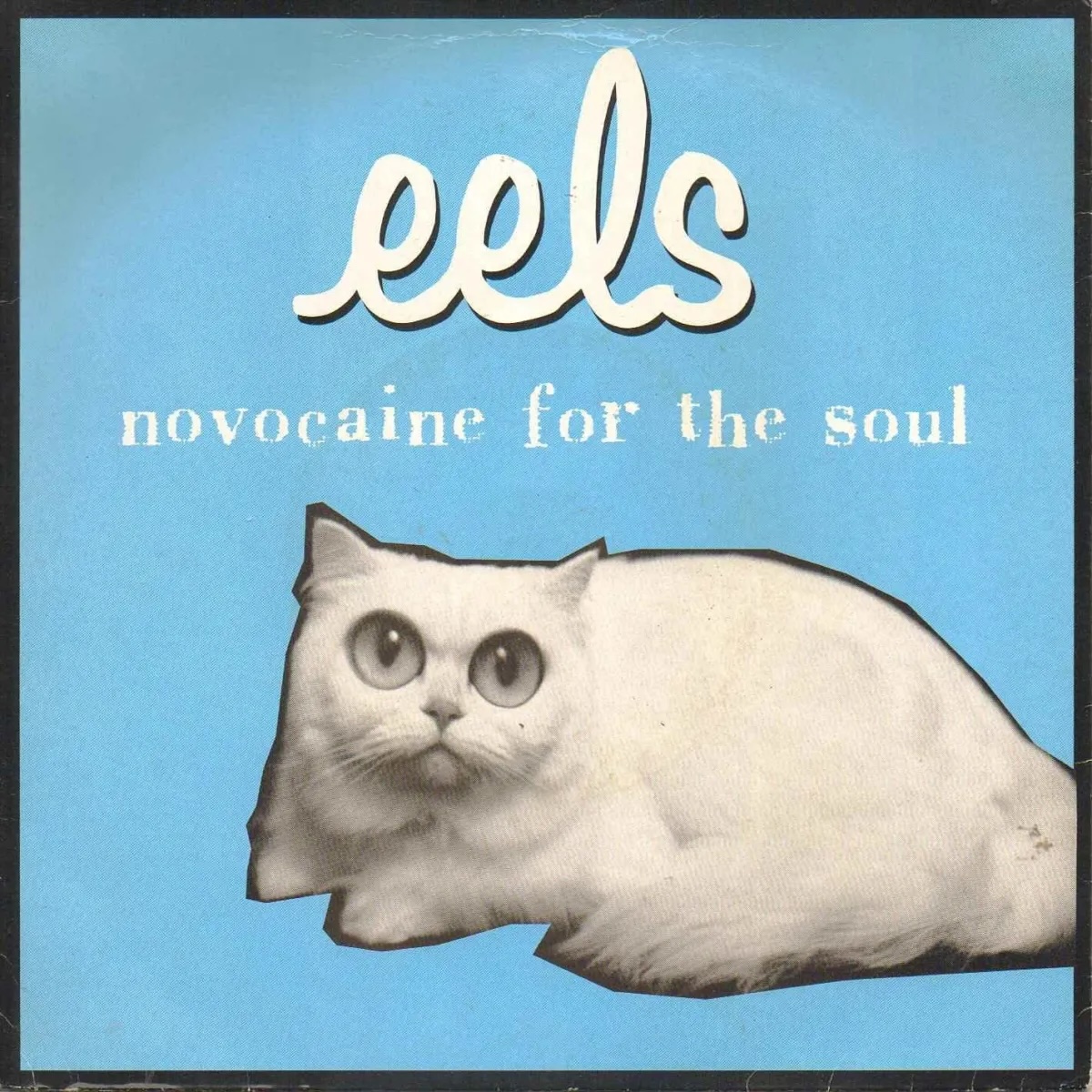
The Alternative Number Ones: Eels’ “Novocaine For The Soul”

October 12, 1996

  • STAYED AT #1:2 Weeks

In The Alternative Number Ones, I’m reviewing every #1 single in the history of the Billboard Modern Rock Tracks/Alternative Songs, starting with the moment that the chart launched in 1988. This column is a companion piece to The Number Ones. The column is now biweekly, alternating with The Number Ones on Mondays.

Depending on how you count them up, there are something like 15 Eels albums. The records might not have been hits, at least in the US, but those records have an audience. Over the years, Eels records have had contributions from big-deal collaborators like Tom Waits, Jon Brion, and R.E.M.'s Peter Buck. Eels songs keep showing up in movies. So does frontman Mark Oliver Everett, the only permanent member of Eels. His scraggly hangdog face is super-recognizable, and he's happy to make a quick walk-on in Ant-Man or whatever. He's made a life for himself in the entertainment business, and he's got a cult fanbase and a huge body of work.

But sometimes, a single image can overshadow everything else in a long career. That's what happened with Eels, but at least the single image is a cool one. It's Everett, then just known as E, in opening of the "Novocaine For The Soul" video — strapping on headphones and drifting gracefully into the air as if ignoring gravity is an in-the-moment decision. Everett already had a couple of major-label solo albums to his name when the "Novocaine For The Soul" clip came out, but it was the world's first glimpse at Eels, the band with him at the center. That image could've been too memorable.

Mark Romanek, one of the all-time music video greats, directed the clip for "Novocaine For The Soul." It's an ecstatically surreal vision in black and white, and the whole thing takes place in an alley. When the song's beat drops —and we'll get to the beat-drop below — we see Everett and his two bandmates hovering over that alley like ghosts. That's all they do in the video, the wires holding them up thin enough that they don't register on camera. (I think this was before you could digitally erase those wires, but maybe not.)

Those guys seem perfectly serene while moving through the zero-gravity dreamscape. They look like astronauts aboard a space station, or maybe like the wuxia warriors of Crouching Tiger, Hidden Dragon. Romanek has fun with the visual conceit, showing them standing sideways on walls or danging from streetlights. When the song ends, the three of them return to the ground and walk slowly and tentatively out of their alley and into the street. It feels like a music-video representation of coming down from a vivid high and having to return to functional human life. It's a truly great music video, and it made an impression.

The song made an impression, too. "Novocaine For The Soul" fit right in with the afterglow of summer 1996, when almost everything on alt-rock radio either was Beck or merely sounded like Beck. Eels didn't sound that much like Beck, but they did share a collaborator in producer Michael Simpson, one half of the Dust Brothers. Anyway, "Novocaine For The Soul" had the right combination of disaffected deadpan vocals and crackly-dusty drum loops for that brief little historical window, and it became the only proper radio hit that Eels ever had. Looking back today, "Novocaine For The Soul" makes perfect sense as a freak hit from a future cult-fame lifer, kind of like "The Letter" for Alex Chilton. But as someone who isn't really in the Eels cult, I will probably always primarily think of them as the guys floating in the alleyway. There are worse ways to exist in the collective memory.

Mark Oliver Everett's father was famous, but not because of anything he did in the entertainment business. Hugh Everett III was a big-deal quantum physicist who developed what would become known as the Many Worlds Theory. So maybe he was important in the entertainment industry, since we now have a bazillion blockbusters about parallel realities. That's the same thing, right? I will embarrass myself if I try to discuss scientific concepts that I don't understand. In any case, Hugh worked at the Pentagon, and the family lived in Northern Virginia. Hugh died of a heart attack at the age of 51, and the 19-year-old Mark was the one who found his body. Later on, Mark took part in Parallel Worlds, Parallel Lives, a BBC TV documentary about himself and his father.

Unlike his father, Everett didn't care about science at all. He loved music as a kid, and he became what he called a "major delinquent" as a teenager. I can vividly remember the SPIN interview where he said that he was once scheduled for two different court appearances on the same day, at the same time. I don't know how you even pull that off. It's impressive. As a young man, he moved across the country to Los Angeles, where he worked day jobs and recorded four-track demos in his spare time. Somehow, he scored a deal with Polydor. Recording under the name E, he released his debut album A Man Called E in 1992. His lush, downcast single "Hello Cruel World" reached #8 on the Modern Rock chart. (It's a 7.)

Even as a young solo artist, E had a warm, craggy heaviness to his voice. He sounded like he was always tired, and that quality rubbed up against the grand, orchestral arrangements that he preferred. E released one more solo album, 1993's Broken Toy Shop, before getting dropped from Polydor. That's when he met drummer Jonathan "Butch" Norton and bassist Tommy Walter and decided to form a band called Eels. The idea was that the Eels records would be right next to the E ones in the record-store racks, but E forgot all about the bands that begin with "Ea," so it didn't really work.

While all this was going on, E was writing and recording demos for the songs that would become Eels' debut album Beautiful Freak. Like a lot of musicians in his generation, E caught on to the idea that he could expand his sonic vocabulary by messing around with samples and loops. Around the same time, Steven Spielberg, David Geffen, and Jeffrey Katzenberg founded DreamWorks Pictures, which was supposed to become a major film studio that could compete with the Universals and Disneys of the world. DreamWorks launched its record-label subsidiary in 1996, and Geffen brought in veteran label guys Mo Ostin and Lenny Waronker to run the label. Eels were one of the first acts they signed to the new label, and Beautiful Freak followed George Michael's Older as the second album to come out on DreamWorks.

A bunch of people helped out on Beautiful Freak. Michael Simpson was one half of the Dust Brothers, the producers behind the Beastie Boys' Paul's Boutique and Beck's Odelay; he worked on the record. So did Jon Brion, who was probably best known at the time as Aimee Mann's producer and who was only just starting to get into film scoring; he'd already sung backup on one of E's solo songs. Another person who'd been around since those E records was Mark Goldenberg, a veteran session musician who'd worked with people like Linda Ronstadt and the Pointer Sisters. Goldenberg is credited with co-writing "Novocaine For The Soul," the song that introduced Eels to the world.

"Novocaine For The Soul" starts out with vinyl crackle and with some excitable old-timey drums and guitar. It's a sample from "Yes, She Knows," a 1961 R&B record credited to Tubby Chess And His Candy Stripe Twisters, taken from an album of twist-craze cash-in songs. (Someone clearly hoped that people would mistake "Tubby Chess" for "Chubby Checker.") It's fun to think about '90s alt-rockers combing through thrift-shop record racks and looking for stuff to sample, just the same as their rap-producer peers.

Over that sample, Eels add some sad music-box piano tinkles and some ominous strings, and the emotional effects of all those different sonic choices rub up against each other nicely. E deadpans some vaguely saucy non-sequitur lyrics: "Life is hard, and so am I/ You better give me something so I don't die." Then suddenly, the guitars and drums come flooding onto the song, and the sample disappears. Before I started work on this column, I'd forgotten about the moment that the song kicks in. It's a beautiful little rush of sonic bliss, and it sounds like the instant that the drugs hit.

Drugs presumably figure heavily into "Novocaine For The Soul," a song about intentionally numbing yourself to the world. I'd already started playing around with weed and acid by the time the song came out, so I was familiar with the concept. It was the same thing that Morphine sang about on "Cure For Pain," and I felt very sophisticated for getting it. E's "Novocaine For The Soul" lyrics are mostly meaninglessly clever one-liners: "Life is white, and I am black/ Jesus and his lawyer are coming back." But his numb, flat vocal effect really does evoke that depressed, narcotized dream-state, and it contrasts with the sheer beauty of the song.

Let's talk about that beauty. In some ways, the arrangement of "Novocaine For The Soul" fits right in with the poppier, glammier edges of post-grunge alt-rock. The big, groovy drums and anthemic power chords fit in alongside what peers like Garbage and Spacehog were doing. Eels also layered on the music-box tinkles and the dramatic strings, and they knew when to throw in a sudden, jarring pause to let the song breathe. There's a gorgeously wigged-out guitar solo in there, too. When E's flat voice becomes just slightly more urgent, the change ripples through the track. I remember liking "Novocaine For The Soul" just fine when it was all over the radio, but it sounds way better to me today than it did then.

"Novocaine For The Soul" would've fit pretty well on early-'90s alt-rock radio, when grunge hadn't quite hit yet and the term "college-rock" was used more widely than "alternative." The combination of smarty-pants remove and pained vulnerability, as well as the sheer songcraft, was miles removed from the 311-type stuff that was in the process of taking over. You couldn't mosh to Eels. But the Beck-style groove of "Novocaine For The Soul" arrived at the right moment, and so did the Buzz Bin video. The song itself really couldn't be denied, either. None of Eels' other music resonated on the same level.

"Novocaine For The Soul" never escaped the modern rock stations, at least in the US, and Beautiful Freak didn't even go gold. The band's follow-up single was "Susan's House," a weird breakbeat-driven spoken-word quasi-rap about the dehumanizing absurdities that E supposedly witnessed while going to visit a girlfriend. "Susan's House" didn't get anywhere near the alt-rock airwaves. But that song and "Novocaine For The Soul" were both top-10 pop hits in the UK, where Eels were immediately huge. In 1997, I went to one day of the Reading Festival, and I caught a few minutes of Eels' headlining second-stage set. I mostly remember seeing E singing into a mic made to look like phone receiver, thinking that it was kind of interesting, and then going back to watch people dance around bonfires to the Orb.

Shortly after Beautiful Freak came out, E's older sister died by suicide, and his mother was diagnosed with cancer. He put his feelings about those terrible life events into Eels' second album, 1998's Electro-Shock Blues. It's heavy, lovely record. Someone gave me a dubbed tape copy during my first year of college, and I listened to it all the time. The overwhelmed feelings and layered orchestrations of Electro-Shock Blues were light years away from where alt-rock radio was going. Electro-Shock Blues found its cult, but lead single "Last Stop: This Town" peaked at #40, and then no other Eels tracks made the Modern Rock chart ever again.

You wouldn't hear Eels songs on the radio, but you might hear them at the multiplex. The Beautiful Freak song "Your Lucky Day In Hell" popped up on the soundtrack of late-'90s movies like Grosse Point Blank and Scream 2. "Cancer For The Cure" was in American Beauty. "Mr. E's Beautiful Blues" was in Road Trip. An E original called "Christmas Is Going To The Dogs" was in the Jim Carrey Grinch movie. Years later, E did most of the score for the 2008 Carrey joint Yes Man, and Carrey sang lead and played Charlton Heston in the Funny Or Die-produced video for the 2013 Eels song "Cold Dead Hand." Hollywood types loved Eels. They still do.

Most consequentially, Eels songs kept showing up in Shrek movies, possibly because of the DreamWorks connection. Today, the Eels song with the most streams isn't "Novocaine For The Soul"; it's "I Need Some Sleep," their contribution to the 2004 motion picture Shrek 2. I have to imagine one could live a comfortable life just on those Shrek royalties. The 2009 Eels song "The Look You Give That Guy" has more streams than "Novocaine," too. That one wasn't in a Shrek movie, so I don't know what's happening there.

Eels music continues to appear in movie soundtracks, and the band's 2009 song "Fresh Blood" served as the opening-credits music for the HBO show The Jinx. E appeared in a bunch of episodes of the Netflix show Love, and I got the impression that he was playing a lightly fictionalized version of himself. He published a 2007 memoir. He's still doing the Eels thing. He's busy!

The other two "Novocaine For The Soul"-era Eels members left a long time ago, and the band became E and whoever else was around and working with him. PJ Harvey collaborator John Parish had a stint as an Eel. The current non-E band members have insufferable alter-egos like P-Boo and Koool G Murder. Eels don't tour all that often anymore, but they have released a steady stream of independent albums, the most recent of which is Eels Time!, from 2024. I don't listen to every new Eels record, but whenever I check in with them, I like what I hear.

The entire Eels saga is a best-case scenario for an alt-rock one-hit wonder. E is a consummate cult artist who was never going to become a radio mainstay, and he's done a lot of interesting work out of the spotlight. He has built what certainly looks like a sustainable career from the outside, and I've never seen any stories about him fucking his own life up. If you're only going to make one hit, you might as well make a great song, and "Novocaine For The Soul" is a great song.

GRADE: 9/10

HEAVY ROTATION: Here's the very faithful "Novocaine For The Soul" cover that Portugal. The Man recorded with Sir Chloe and released in 2021:

(At least theoretically, Portugal. The Man will appear in multiple future columns.)

Stay in touch

Sign up for our free newsletter