
Peter Gabriel is slowly releasing his new album o\i, sharing a single on every full moon. Last month's was the "Looking For The Happy," which he said was about gratitude and "trying to do a little less bitching." Now, with "Face The Wall," he's "looking death in the face."
"After last month, where we were 'looking for the happy,' we can just follow that line all the way through and come to Face the Wall, which is looking directly in the face of death. A nice, cheerful subject," he says in a statement, continuing:
The lyric is partly about getting older, facing illness, and it's looking death in the face, which I think we don't do enough of. I know I've talked about this before, but cultures which seem to include death as a normal part of life seem more comfortable with it and live life to the full. That was the starting point.
Music is a cathartic process for a lot of us and when I'm singing at the end, "I see you coming through" that is a cathartic moment. I think that is an important line; conditions are getting worse and more intense as the song progresses, but with that lyric it suggests there is a reason to be hopeful.
You never quite know when you're in the studio whether the song is going to be a vehicle that can carry people, or not. I know this is going to speak to some people.
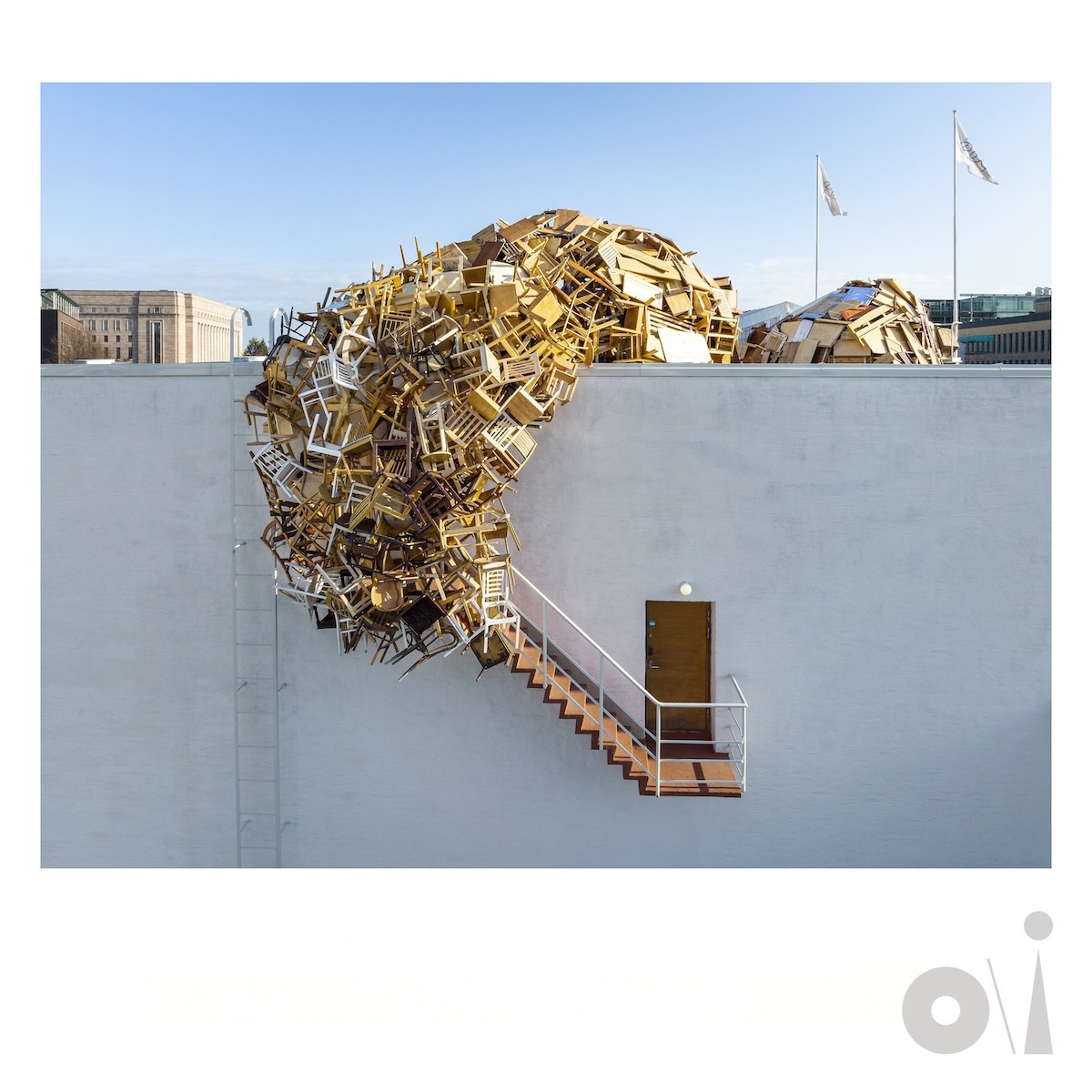
The cover art called "The Nest. Amos Rex" by Tadashi Kawamata and photographed by Mika Huisman. Here's what Gabriel says about it:
When I saw The Nest at Amos Rex, I fell in love with it. To me, the wall is there, big, solid, you know, a bit like death. These messy human chairs are falling over the wall and, somehow, they spill over the top. It's funny, but it's also hopeful and against unbelievable odds.
I wasn't aware of Tadashi Kawamata's work before seeing this image, but this was the thing that got me excited. I thought it was perfect for this song and got me looking at a lot of his other work.
I guess I'm attracted to stuff that is going against the rules or doing what it does in an unconventional way. We are used to seeing art in a museum or on walls, and here it is tumbling over the walls. That feels like a more interesting, adventurous, and unlikely context. Tadashi was taking a lot of the elements, the chairs in particular, from local reclamation sites, so they, if you like, belong to that community, that area. [The Lasipalatsi building in the heart of Helsinki]. The site-specific nature of the work is really something that he's having fun playing with.
An artist to explore for those of you that love this image like I do.
Hear "Face The Wall" below.