

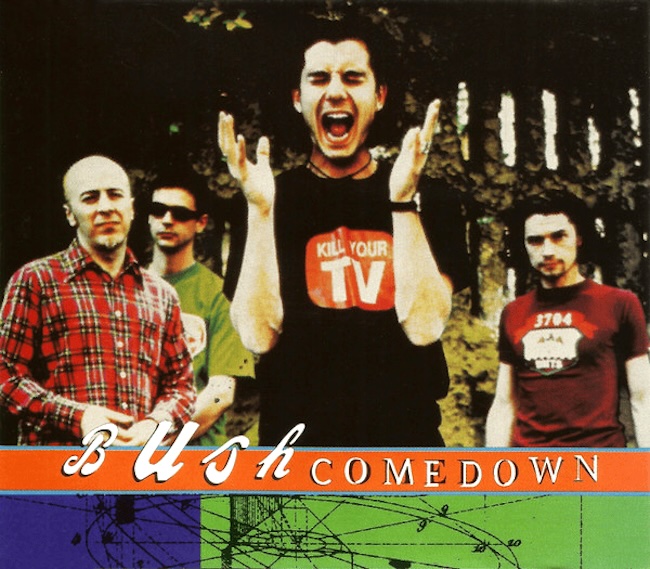
In The Alternative Number Ones, I’m reviewing every #1 single in the history of the Billboard Modern Rock Tracks/Alternative Songs, starting with the moment that the chart launched in 1988. This column is a companion piece to The Number Ones, and it’s for members only. Thank you to everyone who’s helping to keep Stereogum afloat.
In the business of popular music, things are supposed to work in a specific way. A sound or a scene takes off and grabs the public imagination, but many of the people who make that music are self-destructive or reluctant or unreliable in one way or another. So the music business goes off and finds someone else who will make that sound, except now the people making it are all professionals who know what they're expected to do. Maybe one of them is really, really ridiculously handsome. Maybe he's so handsome that the music almost becomes secondary. Maybe he's got a face that demands to be put on magazine covers and thrown into MTV rotation. This business as usual. For some of the kids who grew up on grunge, the arrival of Bush was a perfectly acceptable development. For others, it felt like some kind of betrayal. I was in the second category.
For the first few years that he was famous, Gavin Rossdale had to answer a whole lot of questions about Nirvana. If he was mad about that, he did a good job pretending that he wasn't. Yes, his band sounded a lot like Nirvana. Yes, he loved Nirvana. Yes, he'd been a rich and glamorous '80s London club kid whose previous music ventures sounded nothing like Nirvana. Yes, he was big in America but not in his homeland. All these years later, Rossdale is still making big, brooding rock songs, except now people are way more likely to ask him about Gwen Stefani than Kurt Cobain. There's no reason to believe that he wasn't entirely sincere about wanting to make grand, muscular big-riff rock 'n' roll. But context matters, and the context surrounding Bush felt overwhelmingly cheesy.
Bush's debut album Sixteen Stone came out in November 1994, mere months after Kurt Cobain's suicide. Cobain was still alive when Bush formed and recorded that album. Bush got dropped from one label before getting their big shot on another. But from the moment that Bush properly arrived in the US, they were beneficiaries of a smart, powerful label's full-court press. Interscope was transparently pushing something on us, telling us that Nirvana might be gone but here was this other Nirvana with this insanely handsome lead singer instead. It's an accident of fate that Bush happened to replace fellow fake-grunge posterboys Silverchair at #1 on the Modern Rock charts, but that confluence was telling. The initial moment of '90s alt-rock excitement was over. The pretenders had arrived.
Maybe Gavin Rossdale wasn't a pretender. Maybe he really meant all the shit that he moaned on record. At this point, that context has faded away. Today, Rossdale is now a figure of '90s nostalgia. The rock stars of the not-that-distant past, whether real or Memorex, all seem to carry a certain magic about them today. Rossdale still basically looks like that, so he has more of that magic than most. The magic is lost on me. Plenty of legendary musicians arrived on the scene because record labels wanted to push them into certain slots, but Rossdale is not one of those legends. Today, the real problem with Bush is that most of their songs are pretty bad. "Comedown," their first alternative chart-topper, is one of those.
"Comedown" was the first song that Gavin Rossdale ever wrote by himself. He still loves to tell the story now."Comedown" was the moment that he figured things out. He didn't think he was any good at guitar, so he'd always try to find other musicians to write with. He kept beating himself up about that, and he told himself that he needed to sit down with his guitar and come up with something on his own. He was in a dramatic romantic relationship with a girl, so he sang about the highs and the lows of being with this person, and "Comedown" was what came out. Everything clicked. That would be a great story if the song was any good.
All the members of Bush were in their late twenties when the band started, which meant that they'd all been kids in the UK during the initial late-'70s punk explosion. Gavin Rossdale, the son of a doctor, grew up with money in London, which sounds pretty nice. His parents split up when he was young, and he stayed with his father and learned about punk from his older sister. In the '80s, he hung out at cool-kid London clubs. He didn't dress in the super-flashy style of the time, and he could get away with that because he looked how he looked. At some point, he was in a romantic relationship with Marilyn, the super-androgynous male synthpop singer. (Rossdale used to deny that, but he confirmed it years later.) In 1989, he also had a kid with the fashion designer Pearl Lowe, but he didn't find out about that until years later. Their daughter Daisy Lowe became a successful model. Long before he got famous, Rossdale had quite a life.
In the '80s, Gavin Rossdale and Sacha Puttnam, son of House Of Lords member and Chariots Of Fire producer David, started a new wave band called Midnight. They released a couple of singles on Epic that didn't go anywhere, and then they broke up. Later on, Rossdale told Rolling Stone, "We got signed way too young in the mid-'80s, when everyone was throwing all this money around. We weren’t developed, and we didn’t deliver. So as far as the A&R community in London was concerned, I was soiled." At the same time, Rossdale was also playing semi-pro soccer, but the lifestyle didn't agree with him: "I couldn’t bear not hanging out with girls and taking drugs, to be honest."
Gavin Rossdale moved to Los Angeles for about six months in 1991. He crashed with friends and found work as a PA on music video shoots. For at least some of that time, he stayed with an ex-girlfriend and her new partner -- Jake Scott, Ridley's music-video director son. That was a rough experience for Rossdale. Later on, Jake Scott would direct Bush's "Comedown" video, which is pretty bad.
Around the time that he got back to London, Rossdale was dating Suze DeMarchi, leader of the Australian band Baby Animals, and that's how he met guitarist Nigel Pulsford. Pulsford was in another new wavey group called King Blank. At least according to some accounts, Rossdale and Pulford met at Wembley Stadium, where Baby Animals were opening for Bryan Adams, which is funny to think about. Rossdale and Pulsford started playing music together in a relatively pop-oriented group called Future Primitive. The only song they ever released was called "Bomb." Rossdale and Pulsford found a couple of other members, including a drummer, Nik Hughes, who kind of looked like Rossdale. Eventually, Future Primitive became Bush, and they re-recorded "Bomb" as a grunge song, more or less.
Here's how Rossdale once explained Bush's band name in a SPIN interview: "That's pot in England. Also, I like the ambiguity of the word. In England, you smoke bush, and both men and women have bushes -- which is a very important point, it's not some kind of sexist thing. And we live near Shepherd's Bush. Also, I just like the 'sssh' at the end of the word." You really can't argue with logic like that, can you?
In 1993, George Michael's former manager Rob Kahane signed Bush to his imprint at the Disney-affiliated label Hollywood Records. Bush recorded their debut album Sixteen Stone with producers Clive Langer and Alan Winstanley, two new wave veterans who had worked with a lot of extremely British acts -- Madness, the Stranglers, the Teardrop Explodes, Rossdale's ex Marilyn. They also produced Flood for They Might Be Giants, which is funny. Langer and Winstanley haven't appeared in this column before, but they were in the mainline Number Ones for producing Dexys Midnight Runners' "Come On Eileen." Later on, Nigel Pulsford told the BBC that Bush chose those two producers because they knew they had a very American sound and they hoped those guys could help them "sound more British." It didn't work. Nothing about Sixteen Stone sounds especially British. It just sounds like another record from a 1994 band trying to make grunge, which is what it is.
Soon after Bush finished recording Sixteen Stone, Frank Wells, the guy at Hollywood who approved their deal, died in a helicopter crash. The remaining people at Hollywood didn't care for Sixteen Stone, so Kahane took the completed album to Interscope, who loved it. Interscope really established a reputation in the '90s by jumping on other labels' cast-offs. Sixteen Stone turned out to be another winner for them. Kahane sent an advance copy of Sixteen Stone to KROQ, and that station had "Everything Zen" in rotation before the Interscope deal was even done. Sixteen Stone never got any love from critics, but alt-rock stations across the country started playing the shit out of "Everything Zen." Once MTV got a look at Gavin Rossdale, the "Everything Zen" video went straight into the Buzz Bin.
"Everything Zen" hit huge, staying on the Modern Rock chart for six months and peaking at #2. It also reached #5 at Mainstream Rock and got play on pop stations. I thought the song was OK. (It's a 6.) "Everything Zen" is a big, dumb rocker with big, dumb lyrics. The thing that impressed me most was Gavin Rossdale delivering the line "I don't think so!" with the sassy verve of a Ricki Lake guest. He should've worked "talk to the hand" in there, too, just to make the time-capsule effect complete. The existing lyrics are mostly references to other people's songs, anyway, so it's not like it would've been a compromise of his artistic vision.
Sixteen Stone was already gold by the time that Bush's follow-up single "Little Things" reached its #4 peak in summer 1995. "Little Things" sounds a lot like Nirvana, but not anywhere near as good. (It's a 5.) Bush played ball with American radio programmers. They were on the bill at the 1995 HFStival, my first radio-station fest, but I didn't watch them because I didn't think they were cool. Radio programmers evidently disagreed, since the singles from Sixteen Stone stayed in rotation forever. "Comedown" was the third of those singles, and it was the first to reach #1.
I know "Comedown" is a beloved radio-rock nugget in some circles, but I just can't get into the song. It's a slog. It keeps going forever, hitting all its marks without leaving much impression. Gavin Rossdale sings everything in a thoroughly generic gargle-purr, and when he hits the chorus, he almost begs you to sing along. When he yowls "shoot up" over the guitar solo, I get the feeling he wants me to pat him on the head for being daring. The whole thing feels like a collection of learned rocker-dude gestures. It's just a bore. The only cool thing about it is the bassline, which I liked a lot better when it was the bassline from Massive Attack's "Safe From Harm." (Massive Attack sampled that bassline from jazz drummer Billy Cobham's 1973 track "Stratus," and I guess Bush just sample-jacked it without crediting Massive Attack or Billy Cobham. "Same From Harm" happens to be the only Massive Attack song that ever made the Modern Rock chart; it peaked at #28 in 1991.)
Gavin Rossdale still ends Bush shows with "Comedown," and he still talks about that song as his finest hour. I don't hear it. I guess "Comedown" is Rossdale saying how much he loves the high of sex and infatuation and dreads the inevitable comedown, but like so many other '90s radio-rock songs, it could just as easily be about heroin. Gavin Rossdale doesn't wanna come back down from this cloud! It's taken him all this time to find out what he needs, yeah! He goes into broody mode on the verses, and his lyrics might as well be gibberish: "All police are paranoid/ So am I, so's the future/ So are you, be a creature." Or maybe it's "sweet creature"? "Dear creature"? None of that means anything. It's just the build up to the chorus that Rossdale hollers into the void. The whole point of the quiet-to-loud structure is the tension and release, the cathartic euphoria of the crashing chorus. I don't get any catharsis from "Comedown." I can hear where it's supposed to be, but I never feel it. Mostly, I just wait around for the song to end.
I got really good at switching to another station when "Comedown" came on the radio in 1995, but I don't have that option here. So here I am, just playing "Comedown" over and over, trying to find something to even say about it. This is the best I can do. "Comedown" is a song that exists. The album version goes on for five and a half minutes, and I think that must be the version that was actually on the radio back then, but maybe it just felt that way. It's fucking endless. It just keeps going.
"Comedown" was all over the radio back then; it reached #2 on the Mainstream Rock chart and #30 on the Hot 100. I can recall at least one instance of switching back and forth between two stations that were both playing "Comedown," impatiently waiting for the song to hurry up and finish on one of them. That's what we used to do before streaming. If nothing we liked was on the radio, we had to sit around waiting through the shit that we didn't like. Kids today only know that feeling when they get unskippable YouTube ads, or maybe when their parents force them to listen to Bush in the car. I envy them.
Notably, "Comedown" didn't do shit in the UK. It didn't even chart over there. None of the tracks from Sixteen Stone did any business in Bush's homeland. The UK had its own thing going on by the mid-'90s, and they didn't need to hear their own bands doing warmed-over American-style grunge retreads. In the late '80s and early '90s, British bands pretty much dominated American alt-rock radio, but that era was completely over by the mid-'90s. With one very big and important exception, Britpop bands simply did not get American airplay. By the same token, the UK didn't really care about post-grunge American alt-rock sounds, and Bush might as well have been an American band. To my mind, the British had much better taste in their own bands than we did.
In any case, America loved Bush. All kinds of Bush-related things were popular over here at one point or anther. America loved loved George Bush, George W. Bush, pubic hair, weed, actual vegetation, everything. By the time that "Comedown" reached #1, Sixteen Stone was platinum in the US, with many more copies left to sell. The biggest of the Sixteen Stone singles wasn't even out yet. We'll see Bush in this column again.
GRADE: 4/10
BONUS BEATS: In 2010, TMZ posted leaked footage of Miley Cyrus smoking salvia while listening to "Comedown." It feels weird to post that video here, so I'm not going to do that. I'm simply going to acknowledge that it exists. Instead, let's go with something else. Gavin Rossdale apparently has a new cooking show where he invites celebrities over to his house and cooks dinner for them. Last month, he did an episode with Serena Williams, and he got out the ol' acoustic guitar so that they could sing "Comedown" together -- not just a verse and a chorus, but the entire song. The whole time, they give off the vague impression that they were about to kiss. I don't know, man. It happened, and it was kind of cute. Here it is:


