

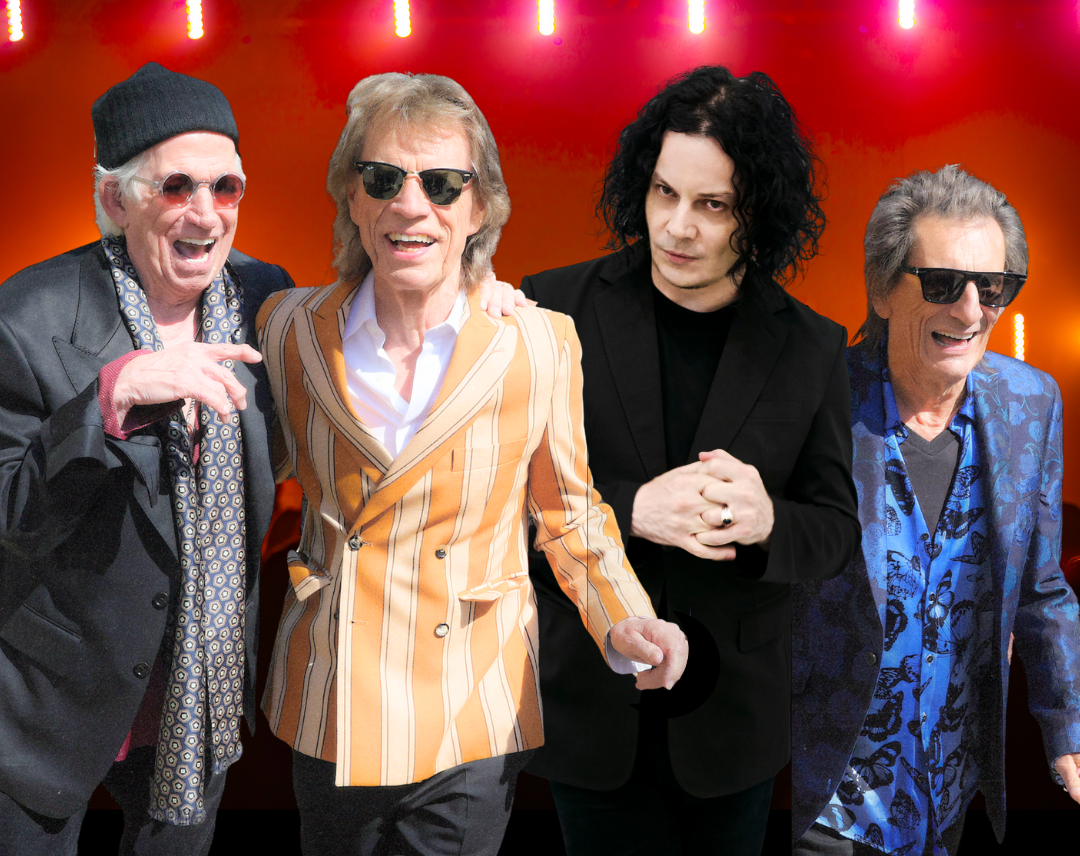
The White Stripes blew up fast. I was a high school senior in 2002, when V2 Records brought the prior year’s White Blood Cells to the MTV2 viewers of America. I remember immersing myself in the album on a portable CD player in the backseat of my parents’ sedan on my way from Columbus to Lansing for a college visit at Michigan State, marveling at the power and versatility of this quirky garage band from nearby Detroit with the fuzzy backstory and the striking color scheme. They seemed incredibly cool, but also raw and lo-fi in a way that prevented me from imagining how quickly they would rocket past rock-critic-famous. In a matter of months, the Stripes were accepting awards at the VMAs, performing on SNL, and selling more than half a million copies of their album. But what really blew my mind was when they opened some arena shows for the Rolling Stones.
The Stones, to me, represented an entirely different world. They were dinosaurs, filthy-rich relics of my parents’ generation, operating on a tier of ubiquity beyond even my own moment’s monsters of rock. They were royalty. They were monoculture. Performing a few tunes before Mick and Keef took the stage at the Air Canada Centre and Nationwide Arena did not mean the White Stripes were now Stones-scale superstars, but it suggested they had soared upward into the maw of the music-business apparatus, into a kind of Actual Rock Stardom that I’d never imagined for such scruffy underground darlings. Yes, this was only a decade after the major labels’ post-Nevermind underground-rock feeding frenzy, but by the time of my TRL-era adolescence, the door to the rock mainstream seemed closed to anyone who couldn’t conceivably be booked for Ozzfest or Warped Tour.
Despite emerging in such different eras, the Stones and Stripes had plenty in common. Both were animated by hooting, hollering early 20th century American music: the blues, country, primitive rock ‘n’ roll. Both seemed gritty compared to their most obvious contemporaries (the Beatles and Strokes, respectively) but knew how to line their skuzzy rock tracks with melody. At their best, they both seemed like ambassadors for a more feral moment in popular music, capable of slick sunshine sounds but grounded in the dirt. Yet by then, the Stones had proven that at a certain scale, even the grimiest rock band can start to feel more like a multinational corporation. They were always doing a radio-friendly, pre-packaged version of their salt-of-the-earth influences. But at a certain point, they were locked in amber — a known quantity rolling out a pre-ordained production of old favorites.
Many understood the White Stripes as throwbacks to some pre-contaminated moment of untamed expression in rock history, and they were certainly uncompromising in their embrace of retro sounds and analog equipment. Their music was filtered through punk, a movement that didn’t significantly impact the Stones’ approach, and Jack White allowed his muse to go places far more idiosyncratic than Jagger would ever dare. Yet in the big picture, these two bands made all kinds of sense together. The Stripes just had to get across the gulf separating Sympathy For The Record Industry from a band so big they transcended the record industry altogether.
The White Stripes always sounded like classic rock, but nowadays they really are classic rock. White Blood Cells just reached its 25th anniversary last week. (It came out two months before 9/11.) Jack and Meg broke through too late for their catalog to be threaded into the public consciousness in the manner of the ’60s giants. Notwithstanding the absorption of “Seven Nation Army” into wordless sports-chant immortality, they don’t really have hits the same way the Stones have hits. White’s still not playing Stones-sized venues, though maybe he would if Meg ever came out of retirement.
Jack White may be living out a muted 21st century echo of the Rolling Stones’ arc, but 15 years on from the White Stripes’ official breakup announcement, he now occupies a similar place within pop culture. He has emerged as one of his genre’s universally accepted public ambassadors: the guitar hero everyone knows, the living embodiment of rock ’n’ roll. He’s the guy Beyoncé turns to when she wants a rocker on Lemonade, the shredder who delights dads across America by bringing out Eminem at the Thanksgiving halftime show. Last year, he and Meg were inducted into the Rock & Roll Hall Of Fame.
So it feels cosmically appropriate that White and the Rolling Stones are both releasing new albums this Friday. The convergence prompted me to consider what I want from these artists at this phase of their careers. Writing about the Strokes a decade ago, Jeremy Gordon posited that for bands beyond a certain popularity threshold, with a certain intangible cool, evolution is no longer necessary: “Becoming classic rock means a band can recycle their iconography without losing their edge, as far as casual and younger listeners are concerned.” At a certain point, you stop expecting your favorite bands to live up to past glories. Some fans might even resent creative progression if it gets in the way of playing the hits.
The Stones, now octogenarians, have nothing left to prove and little to gain by cranking out another LP with boomer whisperer Andrew Watt. They already demonstrated they can still summon decent Rolling Stones songs on their 2023 comeback Hackney Diamonds. As far as we know, this week’s Foreign Tongues is not even an excuse to tour again. They’ll profit from the album — the Stones are one of the few acts with a fan base large and devoted enough to make releasing music a lucrative business — but they can’t conceivably need the money. The official story is that they were inspired, so they kept making music. The lads are in a late-life renaissance, doing it for the love of the game.
That makes Foreign Tongues a fascinating listen. They could conceivably do anything, and they decided to experiment in the most down-the-middle ways possible. Watt came up as a pop producer, and by Rolling Stones standards, Foreign Tongues is a pop record. The production can be overly smooth at times, as if there’s a protective plastic covering over Keef’s hot smoking grooves. Jagger’s hooks feel especially pronounced, as if he crafted them with Max Martin (he didn’t), and they keep coming long after you’d expect the band to settle into blues-vamp filler. I wish I could hear some of these songs as recorded in Muscle Shoals or Nellcôte, and I can’t imagine casually blasting them around the house when the group’s ’60s and ’70s catalog is readily available. Don’t let anyone tell you this one lives up to the classics.
Yet I gotta give the Stones credit for keeping me on my toes. “Divine Intervention” puts Robert Smith and Steve Winwood on the same track and sends Jagger into a startling falsetto on the chorus. “Never Wanna Lose You,” practically a Killers song, is immediately followed by “Hit Me In The Head,” conceivably a Van Halen song. “Back In Your Life” poses the question: What if “Wild Horses” morphed into “Hey Jude” by the end? An Amy Winehouse cover? Sure, why not. For every swing and miss, like the obnoxious “Mr. Charm,” there’s a genuine highlight, like the soulful “Jealous Lover.” Lead single “In The Stars” might sound more like the work of shiny young Stones worshippers than the genuine article, yet it pulls off those pivots between snarling chord-riff verses and an utterly pretty chorus. I’m happy that these guys have rediscovered the joy of creation in their old age, but I’ll be a lot happier if Foreign Tongues leads to more chances to see them in concert.
White, who turns 51 tomorrow, is at an earlier stage of life and career, but the current trajectory of his catalog is not so different. Like the Stones with Hackney Diamonds, he enjoyed his own creative resurgence with 2024’s No Name, a successful return to the rugged and explosive garage rock that first put him on the map. And like the Stones, he’s following that up with another LP that basically adheres to the prior record’s winning formula. The main differentiating factor is that White is still cooking with gas, turning up the heat in a way the Stones simply are not.
Frozen Charlotte, out this Friday, is another batch of straightforward, pointedly lo-fi tracks that prioritize rocking over flights of fancy. Over the course of his solo career, White had followed his muse to some strange and unsatisfying places. I respected the restless audacity, but eventually his records were making me forget why I loved his music in the first place. Around the time of his twin 2022 albums Fear Of The Dawn and Entering Heaven Alive, I thought he had crossed over into his “just play the hits” phase, when I could stop expecting vital new releases and hope for a nostalgia trip whenever he popped up on TV. This back-to-basics retrenchment has proven that he still has the juice.
It turns out monster riffs and electrifying vocal melodies still flow out of White, and when he bashes them out in less-than-pristine fidelity, I could listen to them all day. Like No Name before it, Frozen Charlotte is full of absolute stompers, tracks that let ’er rip within the compact confines of a pop song. Whereas Foreign Tongues is optimized to sound great in brand new $75,000 luxury SUVs, Frozen Charlotte feels ideal for blasting on the shittiest possible car stereos. OK, White probably prefers you listen on vinyl, but in that case, I appreciate how it sounds like it could easily have been recorded with the same setup he used on De Stijl.
I don’t know how White is able to turn the raw ingredients of every shitty blues-rock bar band into ferocious new tracks, but again and again, Frozen Charlotte pulls it off. “You’ll Never Fix Me” shifts shape several times in the first two minutes without losing its breathless momentum, toggling between nasty chord riffs and piercing bursts of lead guitar. “Nobody Knows” gets incredible mileage out of age-old power-chord progressions. Sometimes he ramps up the tempo to the brink of punk rock, as on “She’s In A Frenzy,” and sometimes he slows down into Zeppelin mode, as on “There’s Nobody There,” a moment of peak guitar heroism on an album full of it. Not every song is a stunner — closer “Neighbors Blues” just makes me wish I was listening to “Voodoo Chile (Slight Return)” — but the hit rate is remarkable. I’d be thrilled to see him perform this material, even at the expense of some treasured oldies.
Nothing White records is ever going to hit with the force of the White Stripes catalog. There was a different aura around his work with Meg, an inexplicable chemistry that many have tried to explain anyway. As the 2010s progressed on into the early 2020s, it seemed like maybe he wouldn’t bother trying to recapture that band’s glory. I’m not sure No Name and Frozen Charlotte are the sound of him striving for that. But a quarter-century on, these new albums come as close to that old feeling as I could hope for.
Now, hoping for new records that sound like old ones is maybe not so different from wishing White would just play the hits. It’s still imposing some kind of familiar restraint on an artist who contains multitudes, still confining him to the classic rock category in a way. But viewed another way, I’m merely happy to hear him playing to his strengths. It’s exciting to press play on new Jack White music and feel joy rather than bewilderment, especially knowing that he came back to this approach on his own terms. I don’t know how long he’ll want to keep making records in this vein, but if he wants to turn this into a trilogy, I won’t be bored.
There is one other project I’d like to suggest for him, though. Can we get Jack White in the studio with the Rolling Stones before it’s too late? Ever since Van Lear Rose, we’ve known he loves producing albums for his legendary elders, and we know he worked on music with Richards back in 2009. What kind of raucous, dangerous music could he coax out of the guitarist and his bandmates at this late date? Alternately, what strange, exciting directions might he push them in? Their convergence makes as much sense now as it did in 2002. Hello, operator?